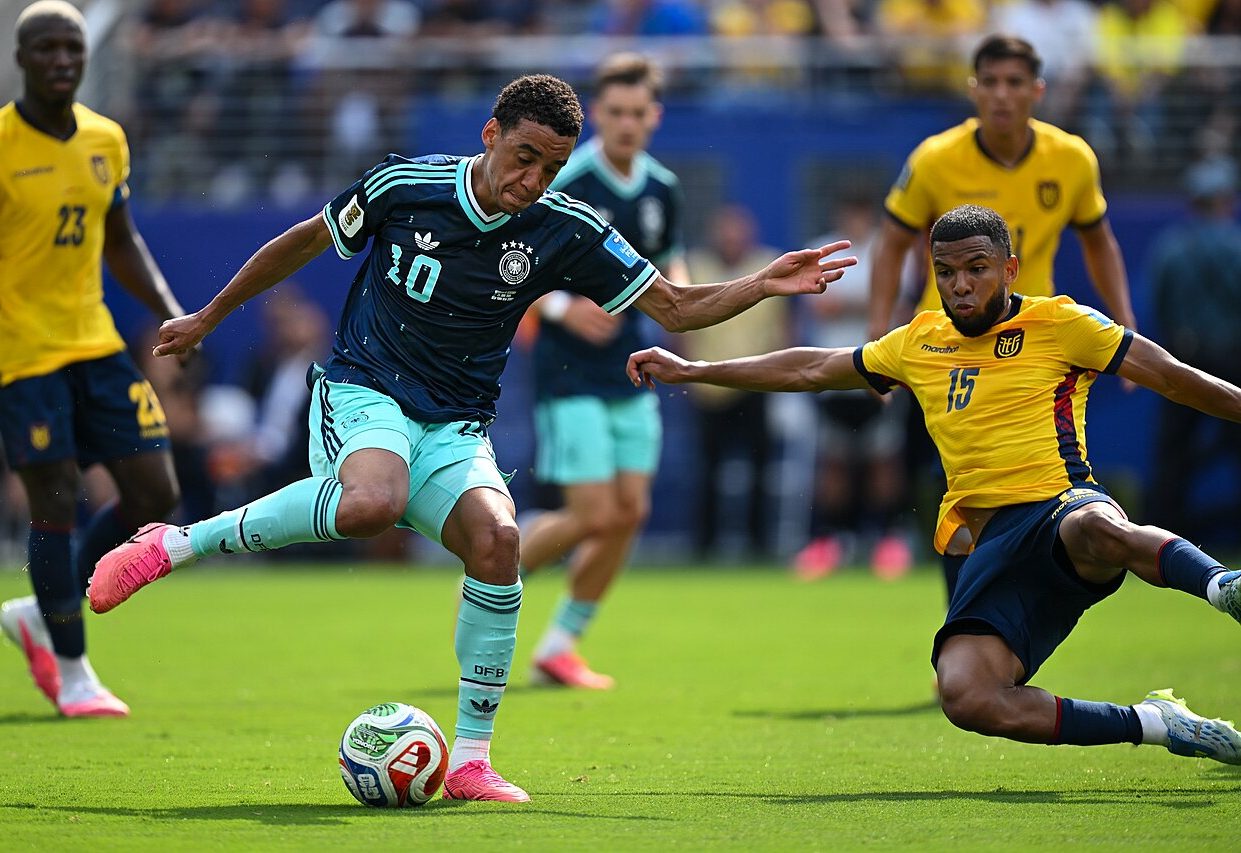
A Bundesliga debut at 17 years and 115 days tends to get noticed. Jamal Musiala reached that mark for Bayern Munich in June 2020, and the detail mattered because it matched the eye test: here was a player moving through elite football at unusual speed, with the balance, close control and calm decision-making of someone older.
What followed was not a sudden flash and fade. Musiala became a regular for Bayern Munich, chose Germany over England at international level, and built a reputation as one of the game’s most elusive attacking midfielders. He can start wide, drift inside, carry the ball through pressure and decide matches without needing many touches to do it.
From Stuttgart to England
Musiala was born in Stuttgart on February 26, 2003. He holds German and English nationality, and his family background is part of what makes his story feel broader than a standard academy rise. His mother, Carolin Musiala, is German and has been described in published profiles as having Polish roots. His father, Daniel Richard, is Nigerian-British.
His early childhood was split between Germany and England. He spent time in Fulda before moving to England at the age of seven, after his mother’s Erasmus-linked move to the University of Southampton. That change of country ended up shaping his football education.
He played for TSV Lehnerz before joining Southampton’s youth setup, then moved to Chelsea’s academy in 2011. At Chelsea, Musiala grew inside one of Europe’s most productive development systems. He was part of the club’s successful youth sides and featured in an age group that won the U18 Premier League, the FA Youth Cup and the U18 Premier League Cup in the 2017-18 season.
There was also a life outside the academy circuit. He attended Corpus Christi School and later Whitgift School, following a path familiar to many elite youth players in England: school, training, travel, matches, repeat. By the time he was a teenager, though, a major decision was approaching.
In July 2019, Musiala left Chelsea and joined Bayern. The move was widely linked to personal reasons and to uncertainty around Brexit, although the exact weighting of those factors has not always been spelled out publicly by the player in detail. What is clear is that Bayern saw an opening, and took it.
Bayern’s fast-track talent
Bayern did not throw him straight into the senior side. Musiala first appeared for Bayern Munich II, making his professional debut for the reserve team in June 2020. He played 10 matches and scored twice as the second team won the 3. Liga title.
Then the first-team breakthrough came almost immediately.
On June 20, 2020, he made his Bundesliga debut for Bayern’s senior side and became the club’s youngest Bundesliga debutant. Three months later, on September 18, he scored against Schalke and became Bayern’s youngest Bundesliga goalscorer at 17 years and 205 days.
Those records told part of the story. The more important part was how naturally he fitted. Musiala did not look like a player surviving on promise alone. He received the ball in tight spaces, turned away from pressure and accelerated into gaps that seemed too small to exist. Coaches value that because it changes the geometry of attacks. Defenders backpedal, midfield lines break, and passing lanes appear.
His rise continued in Europe. In February 2021, he scored against Lazio and became Bayern’s youngest Champions League scorer at 17 years and 363 days. By then he was no longer just a gifted academy graduate with a few records attached. He was part of the rotation in a side expected to win every week.
Silverware came quickly because of the team he had joined, but Musiala’s role in it grew season by season. Bayern won the Bundesliga in each of his first four full seasons in the senior setup, and he was also part of squads that lifted the Champions League, UEFA Super Cup, FIFA Club World Cup and multiple DFL Supercups in that early stretch. He picked up the Bundesliga Rookie of the Month award in April 2021, a smaller line on the honors list, but one that captured how fast he had moved from prospect to first-team contributor.
Becoming central at Bayern Munich
As the seasons went on, Musiala stopped being framed mainly as a teenager with unusual poise. He became one of Bayern’s central attacking pieces.
That shift showed up in his role as much as in his numbers. He could play as an attacking midfielder, off the left, off the right, or in hybrid positions that changed from phase to phase. What Bayern valued was not simply versatility, but the specific kind of threat he brought. He could beat a man without needing open grass in front of him. He could carry the ball through a crowded middle third. And once defenders stepped out to stop the dribble, he had the vision to slip in the next pass.
The number 10 shirt eventually became part of that picture too, a visible sign of status at a club where shirts tend to carry history.
Some of the statistical claims circulating about his Bayern career go beyond what can be safely fixed in a timeless profile, especially when tied to very specific cut-off dates. What is beyond dispute is the broader arc: Musiala moved from Bayern II to the first team in 2020, quickly set age-related club records, and developed into a regular source of goals, assists and progression through the middle of the pitch.
He also signed a long-term contract extension with Bayern, underlining how highly the club values him. Transfermarkt has regularly placed him among the most valuable young attackers in Europe, which fits both his output and his age profile, even if market values are always estimates rather than hard facts.
Germany, England and a big international decision
For a while, one of the biggest questions around Musiala was not how good he might become, but which country he would represent.
Because of his background and upbringing, he was eligible for both Germany and England, and he had played youth international football in both systems. In the end, he chose Germany. Reports at the time said Joachim Löw’s plans for Euro 2020 helped persuade him, and Bayern reporter Manuel Bonke reported that Germany may have offered a clearer route to becoming a starter.
What happened next is clear enough. He made his senior Germany debut against Iceland in March 2021. At the delayed Euro 2020 tournament, played in 2021, he became the youngest German player to appear at a major tournament, doing so at 18 years and 117 days.
At the 2022 World Cup, he was the first German teenager to play at the tournament since 1958. Germany exited in the group stage, but Musiala’s performances still reinforced his importance. He looked like a player the team could build around rather than simply include.
That status grew further at Euro 2024, where he finished as a joint winner of the Golden Boot with three goals. By then, he was no longer the exciting young option in Germany’s attack. He was one of its reference points.
Cap and goal totals move quickly and can date a profile fast, but Musiala has already built a substantial international record while still in the early phase of his career. He has also been recognized with Germany’s International of the Year award, another sign of how quickly he became central for the national side.
Why defenders hate facing him
There are plenty of attacking midfielders who look elegant on the ball. Musiala is more awkward for opponents than elegant suggests.
He is right-footed, but his game is less about a dominant foot than about rhythm, body shape and timing. He glides rather than sprints in the obvious way. He shifts the ball late. He invites pressure, then slips away from it. That is why his dribbling stands out so much on both the eye test and the data.
The term “progressive carries” fits him well, but it can sound sterile. In practice, it means he moves attacks forward himself. He does not always wait for the perfect passing pattern to appear. He can create the next phase by driving through it.
That ability makes him valuable in several zones. Between the lines, he can receive on the half-turn and attack a retreating defense. From wider starting positions, he can come inside and combine. Near the box, he has the composure to finish rather than just decorate a move.
The nickname “Bambi,” given to him by Leroy Sané, captures part of the visual impression: light steps, quick changes of direction, an almost delicate way of moving. But there is steel in the game too. Players do not become decisive at Bayern by being merely pretty on the ball.
Off the pitch: family, school and a relatively quiet profile
For someone so visible on the field, Musiala has kept much of his private life fairly contained in public.
The broad outline is known. He grew up between Germany and England, stayed close to his family, and returned to Germany as his career accelerated. His mother and father are part of the documented public story around him, and he has younger siblings, Jerrell and Latisha.
Beyond that, there is not much verified public material that needs embellishing. No widely confirmed public record places a partner or children at the center of his profile, and that absence matters in a media environment that often fills gaps with gossip. Where details are limited, it is better to leave them limited.
One reported lifestyle detail is that he moved into his own apartment in central Munich, a small marker of independence in a career that had already become very public at a young age. Commercially, Nike has been listed as his boot sponsor.
What comes through most strongly off the pitch is not spectacle but shape: a player formed by two countries, a strong family base, elite academy training and an unusually smooth transition into top-level football.
FAQ
What position does Jamal Musiala play?
He mainly plays as an attacking midfielder, but he can also operate as a winger.
Which club does Jamal Musiala play for?
He plays for Bayern Munich.
Did Jamal Musiala play for Chelsea?
Yes. He spent key development years in Chelsea’s academy before joining Bayern in 2019.
Which national team did Jamal Musiala choose?
He chose Germany at senior international level, despite also being eligible for England.
What is Jamal Musiala’s nickname?
His widely known nickname is “Bambi.”
When did Jamal Musiala make his Bayern debut?
He made his Bundesliga debut for Bayern’s first team on June 20, 2020.
Photo: YantsImages, CC BY-SA 4.0, via Wikimedia Commons