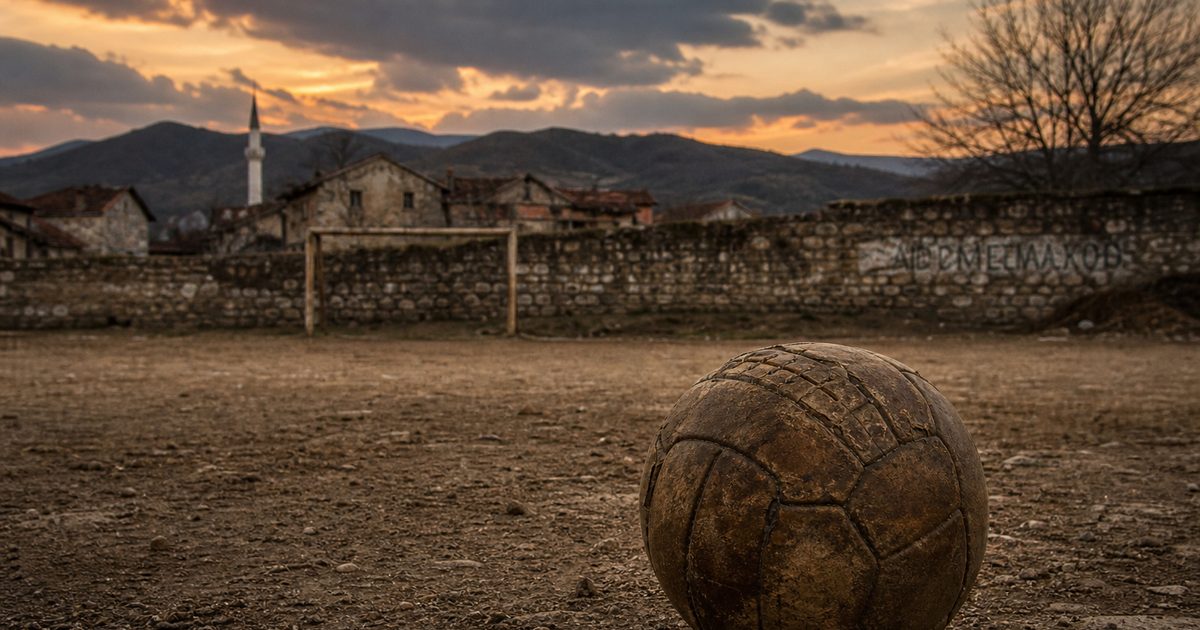
A parking lot outside a refugee hotel is one of the enduring images of Luka Modrić’s story. Long before the Ballon d’Or, the Champions League medals and the status he built across Europe, there was a boy from Zadar using football as routine, escape and ambition at once.
From wartime childhood in Zadar to Dinamo Zagreb
Luka Modrić was born on September 9, 1985, in Zadar, then part of SR Croatia in SFR Yugoslavia. His childhood was shaped by the Croatian War of Independence, which forced his family from home. The most painful loss came in December 1991, when his grandfather, Luka Modrić Sr., was killed. That history is central to any honest account of his rise, not as decoration, but because it explains the resilience behind it.
He played constantly as a child, including in the hotel car park where many displaced families were living. Coaches noticed his touch and awareness early, even if his slight frame made some clubs hesitate. Hajduk Split, according to widely repeated accounts from his early years, passed on him when he was still a boy because he looked too small for the demands of the game.
His formal youth development began at NK Zadar before a move to Dinamo Zagreb’s academy in 2000. There, under the guidance of youth coach Tomislav Bašić, Modrić refined the qualities that would define him later: balance, clean technique, quick scanning and a calmness that made the game seem slower around him.
Loan spells that toughened him up
Dinamo had signed a gifted midfielder, but his first real education came away from Zagreb. In 2003-04, he joined Zrinjski Mostar on loan in Bosnia and Herzegovina. It was a demanding environment for a teenager: physical, direct and unforgiving. Instead of being pushed aside, he adapted. He impressed enough to be named Bosnian Premier League Player of the Year, an early sign that his game could survive outside youth football.
Another loan followed at Inter Zaprešić in 2004-05. By then, the doubts about whether he could handle senior football were fading. He was no longer just a prospect with neat feet. He was influencing matches, taking responsibility and showing that intelligence could compensate for any lack of size.
When he returned to Dinamo Zagreb, he did not take long to become the team’s midfield reference point.
Dinamo Zagreb’s conductor
Modrić’s senior Dinamo years ran from 2003 to 2008, though the loan spells mean his real breakthrough came slightly later. Once established, he became the player around whom the side moved. Across all competitions for Dinamo, he made 128 appearances and scored 32 goals; in the league, he played 94 matches and scored 26 times.
The trophies arrived in sequence. Dinamo won three straight Croatian league titles from 2005-06 to 2007-08, plus Croatian Cups in 2006-07 and 2007-08, and the Croatian Super Cup in 2006. Modrić was named Croatian Football Hope of the Year in 2004 and Prva HNL Player of the Year in 2007.
By then, his style was already familiar: he could receive under pressure, turn away from trouble and pick the next pass before others had seen it. He was not a midfielder built on force. He controlled games with timing.
Tottenham: a Premier League test
A fee of around £16.5 million took him to Tottenham Hotspur in 2008. It was the first major transfer of his career and, in some ways, the first time he had to prove himself all over again. English football was faster, more physical and less forgiving in midfield spaces.
His first months were mixed, but they mattered. Modrić learned where he could influence Premier League matches and where he had to adjust. Harry Redknapp eventually moved him into deeper central areas more often, and that shift suited him. Instead of being judged on goals or power, he began to dictate games through rhythm, retention and passing range.
Between 2008 and 2012, he made 160 appearances for Spurs in all competitions and scored 17 goals; in the Premier League, he played 127 times and scored 13. Those numbers only tell part of the story. More important was the authority he developed in possession. He could play as a central midfielder, an advanced playmaker, a deeper controller or, when needed, from the left drifting inside.
The old nickname “the Zadar Cruyff” followed him into England, though it worked best as shorthand for elegance rather than direct comparison. What stood out was his ability to connect a team: defenders trusted him as an outlet, attackers trusted him to find them early.
Real Madrid and a decade of silverware
In the summer of 2012, Real Madrid signed him from Tottenham for a fee widely reported at around €35 million, roughly £30 million at the time. The move placed him in a dressing room full of stars and under a level of scrutiny that can swallow players whole.
His start in Spain was not smooth. He arrived after a disrupted pre-season and needed time. But once he settled, he became one of the defining midfielders of the era. Over 13 seasons with Madrid, Modrić played 597 matches and scored 43 goals in all competitions.
The honours list is long because his influence lasted so long. With Real Madrid, he won:
– 6 UEFA Champions League titles
– 4 La Liga titles
– 2 Copa del Rey trophies
– 5 Spanish Super Cups
– 5 UEFA Super Cups
– 5 FIFA Club World Cups
– 1 FIFA Intercontinental Cup
That run made him the most decorated player in Real Madrid history, surpassing previous club marks late in his spell there. It also cemented his place among the most successful Croatian footballers ever.
The peak individual year was 2018. Modrić captained Croatia to the World Cup final, won the Golden Ball at the tournament, and then collected the Ballon d’Or, The Best FIFA Men’s Player and UEFA Men’s Player of the Year. It was the season in which he broke the long awards monopoly held by Lionel Messi and Cristiano Ronaldo.
He also collected repeated recognition across the years: multiple FIFA FIFPRO World 11 selections, several UEFA Team of the Year nods, and two Champions League Midfielder of the Season awards. In 2019, he added the Golden Foot.
Croatia’s captain and record holder
His Croatia debut came on March 1, 2006, in a friendly against Argentina. From there, he became the face of a national team across nearly two decades. Modrić went on to set Croatia’s all-time caps record, reaching 194 appearances and scoring 28 goals.
He played at the World Cups of 2006, 2014, 2018 and 2022. Croatia did not qualify for the 2010 tournament, and there was no 2026 World Cup appearance to include in his record. The defining campaign was 2018 in Russia, when he led the side to the final and won the tournament’s Golden Ball. In 2022, Croatia finished third, and he received the Bronze Ball.
At the European Championship, he appeared in 2008, 2012, 2016, 2020 and 2024. He was named in the Euro 2008 Team of the Tournament, and at Euro 2024 he became the oldest goalscorer in the competition’s history. Croatia also finished runners-up in the 2022-23 UEFA Nations League, losing the final to Spain on penalties.
For Croatia, his importance was never only technical. He set the tempo, but he also carried the emotional weight of the team, especially in tournament football where composure becomes contagious.
How Luka Modrić plays
Some midfielders dominate through speed, some through strength. Modrić has always done it through clarity. He scans constantly, receives on the half-turn and makes difficult decisions look obvious.
At his best, he combines short passing in crowded areas with long distribution into space. He can accelerate a move with one touch or slow a game down until the right lane opens. Defensively, he has never been a pure destroyer, but he reads passing lines well, presses intelligently and recovers loose balls through anticipation rather than force.
That is why he has worked in different systems and roles: as a No. 10 in his younger days, as a central midfielder in a three, as a deep-lying playmaker, and as the player who links all phases together. Any Luka Modric biography that reduces him to one position misses the point. His gift has always been interpretation.
Life off the pitch
The personal side of Modrić’s story is unusually well known because the early hardship is so closely tied to his public image. Still, beyond the war years, he has generally kept his private life measured and low-profile.
He is married to Vanja Bosnić, and the couple have children. Reports in the Spanish media have stated that the family lived in Madrid during his Real Madrid years, and those same reports linked him to the purchase of a property there.
In business, Modrić became a minority owner in Swansea City, a move confirmed by the club and notable because it showed an interest in football beyond his playing career. Commercially, he has worked with several brands over the years, including Nike and Hublot, while other endorsement links have been reported in advertising and licensing announcements.
One public controversy did touch his career. In 2017, he testified in court in the case involving former Dinamo Zagreb executive Zdravko Mamić. That testimony, and later scrutiny of parts of it, became a matter of public record. It belongs in his story because it was significant, but it sits apart from his football record.
As for figures around Luka Modrić net worth, those should be treated carefully. Celebrity wealth estimates are widely circulated, but they are not official financial disclosures. Reported salary numbers during his Real Madrid years often placed him among the club’s high earners, yet exact totals vary by source.
The late-career chapter
Modrić left Real Madrid after the 2024-25 season, closing one of the most successful club spells of the modern era. Any account that lists AC Milan as his current club or assigns him appearances there is inaccurate. He did not join Milan after leaving Madrid.
That matters because a profile should not blur confirmed history with invented continuation. The true shape of his career is strong enough without it: a midfielder from Zadar who turned survival, craft and consistency into one of football’s most distinguished careers.
FAQ
How old is Luka Modrić?
He was born on September 9, 1985.
What position does Luka Modrić play?
He is a central midfielder, though he has also played as an attacking midfielder and deep-lying playmaker.
Has Luka Modrić won the Ballon d’Or?
Yes. He won the Ballon d’Or in 2018.
How many Champions League titles has Luka Modrić won?
He won 6 UEFA Champions League titles with Real Madrid.
How many caps does Luka Modrić have for Croatia?
He holds Croatia’s caps record with 194 international appearances.
Did Luka Modrić play in a World Cup final?
Yes. He captained Croatia to the 2018 FIFA World Cup final.