The image still fits Federico Valverde better than any slogan could: extra time in a final, Álvaro Morata racing through on goal, and Valverde deciding that the only way to save Real Madrid was to bring him down. He was sent off, Real Madrid went on to win the 2020 Supercopa de España, and Valverde was named man of the match. It was a split-second act, but it summed him up neatly, urgency, sacrifice, and the sense that he can cover half the pitch before most players have turned.
That edge has carried him from Montevideo to the top level of European football. Born on July 22, 1998, Federico Santiago Valverde Dipetta grew into far more than a promising midfielder from Uruguay. At Real Madrid, he developed into one of the squad’s most trusted all-round players, capable of starting in central midfield, filling in on the right, or even dropping to right-back when a game demanded it. For Uruguay, he became a regular before he had fully settled into club life in Spain.
Growing up in Montevideo
Valverde was born in Montevideo and began playing as a child at Estudiantes de la Unión before joining Peñarol’s youth system. That move mattered. Peñarol has long been one of Uruguay’s great finishing schools, and it gave him the kind of competitive environment that tends to sharpen talented teenagers quickly.
Even in those early years, there was a detail that later stood out. One of his football heroes was Diego Forlán. In time, Valverde would share a dressing room with him at Peñarol, the sort of leap that says plenty about how quickly his own reputation rose.
He was not shaped as a decorative midfielder. From the start, his game leaned on running power, intensity and a willingness to do difficult work without much fuss. Coaches also noticed something else early: he could absorb instructions and adapt. That flexibility would become one of the defining features of his career.
Peñarol and the first step into senior football
Valverde made his senior debut for Peñarol in 2015. He was still a teenager, and his first-team numbers were modest rather than spectacular, but the breakthrough was real. During the 2015-16 campaign, he made 12 league appearances as Peñarol won the Uruguayan Primera División.
That season was enough to convince Real Madrid to move. The Spanish club signed him in 2016, with the transfer fee widely reported at around €5 million. For a young midfielder coming out of Uruguay, it was a major jump, not only in level, but in expectation.
Learning the trade in Spain
Real Madrid did not rush him straight into the spotlight. Valverde began with Real Madrid Castilla in 2016-17, making 30 appearances and scoring three goals. It was a useful year, perhaps a necessary one. He had to adjust to a new country, a different rhythm of football, and the pressure that comes with wearing the shirt of one of the world’s biggest clubs.
His first-team debut followed in 2017, but another developmental step came soon after. He spent the 2017-18 season on loan at Deportivo La Coruña, playing 24 La Liga matches. Deportivo were relegated that year, so it was hardly a glamorous loan, yet it gave him regular top-flight football and exposed him to the demands of surviving difficult games in Spain.
Those months helped harden his game. He returned to Madrid better prepared for the pace, tactical detail and physical demands of elite football.
Breaking through at Real Madrid
The climb at Real Madrid was steady rather than explosive. Valverde did not arrive as the finished article, and that may have helped him. He earned trust gradually, first as an energetic option in midfield, then as a player managers could rely on in almost any tactical setup.
By the time he passed 300 appearances for the club, he had become one of the most important connectors in the side. He could press, recover, carry the ball forward, arrive late in the box and, when needed, protect a lead with discipline rather than flair. That range made him especially useful in knockout football.
His honours list reflects how central he became. With Real Madrid, Valverde won La Liga titles in 2019-20, 2021-22 and 2023-24. He also lifted the Copa del Rey in 2022-23 and won the Supercopa de España in 2019-20, 2021-22 and 2023-24. In Europe, he was part of the teams that won the UEFA Champions League in 2021-22 and 2023-24, adding UEFA Super Cups in 2022 and 2024.
There were world titles too: the FIFA Club World Cup in 2018 and 2022, followed by the FIFA Intercontinental Cup in 2024.
Some moments stand out more than medal counts. The red card in the Supercopa final remains one. Another came in the 2022 Champions League final, when his low ball across goal created Vinícius Júnior’s winning finish against Liverpool. It went down as an assist, but it was also a reminder that Valverde’s influence often arrives at full speed, from wide areas, and at exactly the right time.
He has also added more goals to his game over time, particularly from distance and from late runs into space. That evolution turned him from a high-energy midfielder into a broader attacking threat.
Real Madrid extended his contract in November 2023 through to June 2029. Reported salary figures and market valuations vary by source, so they are best treated as estimates rather than fixed facts.
Uruguay: from youth standout to senior regular
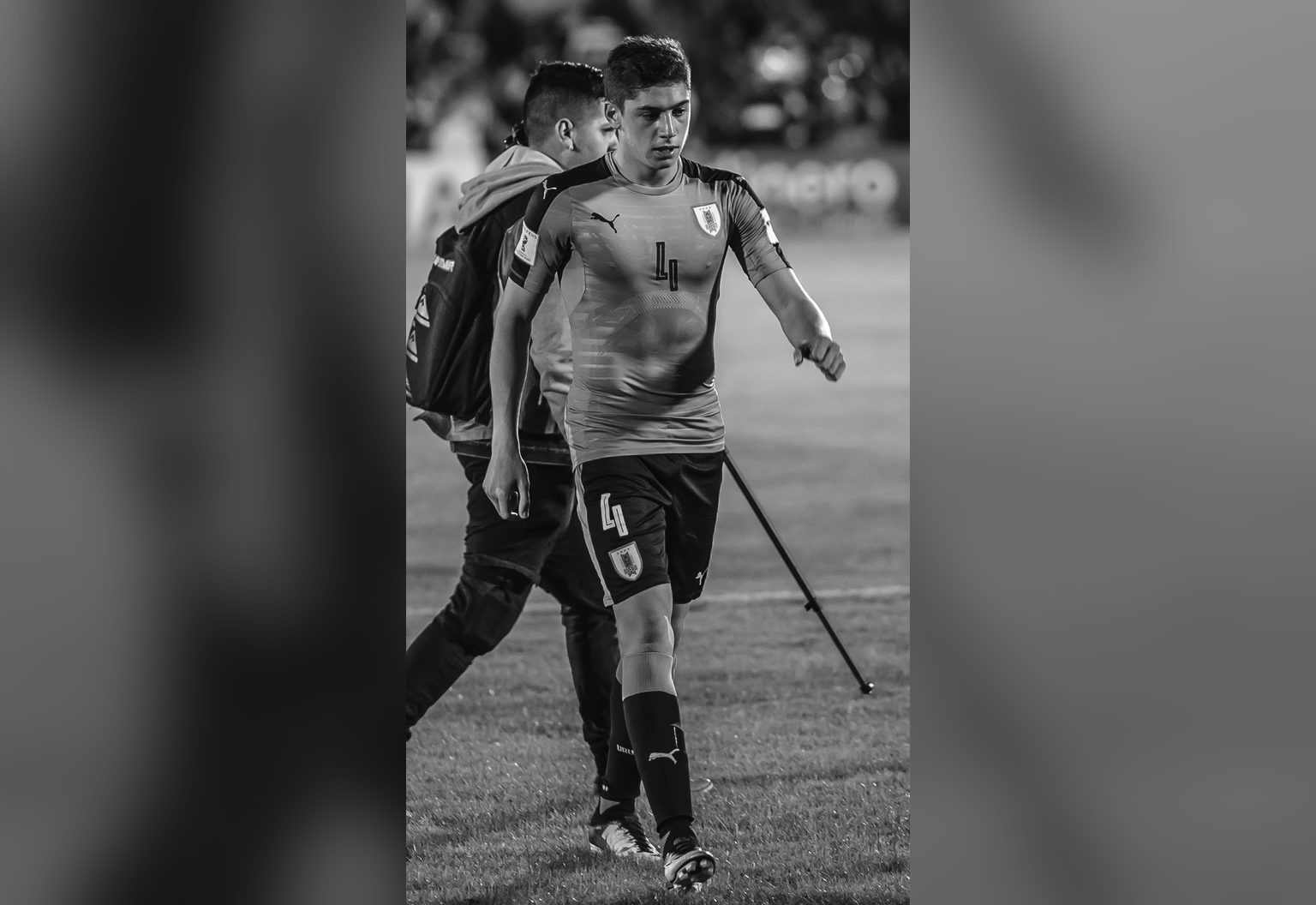
Before he had fully established himself in Madrid, Valverde was already making an impression with Uruguay. At the 2017 FIFA U-20 World Cup, he helped his country finish fourth and won the Silver Ball, a significant early marker of his talent on the international stage.
His senior debut came on September 5, 2017, against Paraguay. From there, he became a regular part of Uruguay’s midfield. He featured at the Copa América in 2019, 2021 and 2024, with Uruguay finishing third in the 2024 edition. He also played at the 2022 World Cup.
Uruguay won the China Cup in 2019, a minor title in the wider picture, but another step in his growing international résumé.
Cap and goal totals change over time, but the broader point has stayed the same: Valverde moved quickly from prospect to fixture for his national team.
What kind of midfielder is Federico Valverde?
Calling him a central midfielder is accurate, but incomplete. He is more like a problem-solver with elite running power.
Valverde’s game is built on acceleration, stamina and timing. He can cover ground defensively, press with aggression, and then turn the same recovery run into an attacking transition. He strikes the ball cleanly, especially from range, and he has the tactical discipline to play in different roles without making a team feel unbalanced.
That is why coaches have trusted him not only in midfield but also on the right side, where his pace and work rate can protect a full-back while still giving the attack width and directness. In certain matches, he has even been used at right-back.
His nicknames tell part of the story. Early on, he was often called El Pajarito, the little bird. Later came El Halcón, the falcon, a label that better matched the force and authority in his game as he matured.
Life away from the game
Off the pitch, Valverde has kept a relatively low public profile compared with some teammates. He is in a relationship with Argentine journalist Mina Bonino, and the couple have two sons.
Commercially, he has been associated with Nike.
One episode from his younger days still appears in accounts of his career. During the 2017 FIFA U-20 World Cup, Valverde made a celebration that drew criticism. He denied racist intent and said it was a tribute to his agent; FIFA requested an explanation at the time. It remains a documented incident, but not one that has defined his public image in the years since.
What has defined it, instead, is reliability at the highest level. Real Madrid have used him in big games because he gives them movement, balance and intensity. Uruguay rely on him for many of the same reasons. And while others may draw more attention, few modern midfielders are asked to do as much ground-level work, in as many different roles, with as little fuss.
FAQ
What position does Federico Valverde play?
He is primarily a central midfielder, but he has also played on the right side of midfield or attack and has filled in at right-back.
When did Federico Valverde join Real Madrid?
Real Madrid signed him from Peñarol in 2016. He started with Castilla before making his first-team debut in 2017.
How many Champions League titles has Federico Valverde won?
He has won the UEFA Champions League twice with Real Madrid: in 2021-22 and 2023-24.
What is Federico Valverde’s nickname?
He has been known as El Pajarito and El Halcón.
Is Federico Valverde married?
Publicly available reporting identifies him as being in a relationship with Argentine journalist Mina Bonino.
What shirt number does Federico Valverde wear?
He wears the number 8 for Real Madrid.
Photo: Jimmy Baikovicius from Montevideo, Uruguay, CC BY-SA 2.0, via Wikimedia Commons