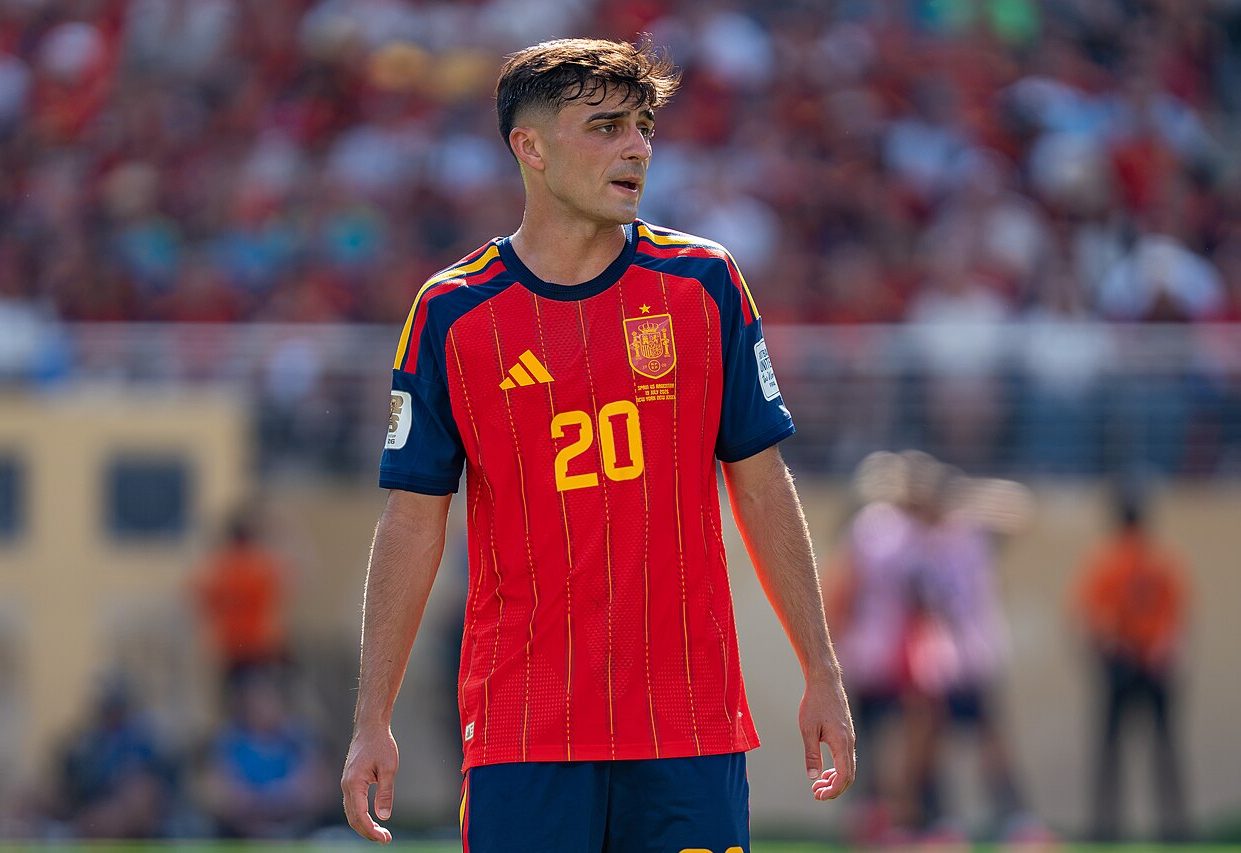
At 16, Pedri walked into professional football with Las Palmas and looked as if the pace of the game had already slowed down for him. That calm has followed him all the way to Barcelona and the Spain national team, where his reputation has been built less on flash than on timing, touch and the ability to make a match bend to his rhythm.
From Tenerife to Las Palmas
Pedro González López was born on November 25, 2002, in Bajamar on Tenerife, and grew up in nearby Tegueste after his family moved there when he was still very young. The island never became a footnote in his story. Even after his rise to the top level, Tenerife remained central to his identity, both through family life and through the way he speaks about home.
His early football education began at Tegueste, before he moved on to Juventud Laguna and then into the Las Palmas system. Those youth years shaped the qualities that would later define the Barcelona midfielder: close control in tight spaces, awareness before receiving the ball, and a natural feel for when to speed a move up or let it breathe.
One detail from that period has become part of the Pedri story. He had a trial with Real Madrid as a teenager, but did not stay on. Reports in Spain have long linked that rejection to difficult weather conditions, with snow disrupting the sessions. Whether told as anecdote or turning point, it sits neatly in the background of what came next.
Like many technically gifted Spanish midfielders of his generation, he grew up admiring Andrés Iniesta. The comparison can be overused, but the influence is easy enough to spot: not in imitation, but in the preference for angles, combinations and control over force.
The Las Palmas breakthrough
His rise at Las Palmas was quick and unmistakable. Pedri made his professional debut in the Segunda División on August 18, 2019, against Huesca, becoming the club’s youngest player in the professional era at 16 years, 8 months and 23 days.
He was not eased in for long. During the 2019-20 season, he made 37 appearances in all competitions and scored four goals, numbers that only tell part of the story. What stood out more was how naturally he handled senior football. He did not play like a teenager filling minutes; he played like someone already reading the game a step ahead.
That season also brought a club record. When he scored against Sporting de Gijón in September 2019, he became the youngest goalscorer in Las Palmas history.
Barcelona had already moved by then. On September 2, 2019, the Catalan club agreed a deal to sign him for a reported initial fee of €5 million, with variables that could increase the total significantly. Pedri stayed at Las Palmas for the rest of the campaign, which proved ideal for his development. By the time he arrived at Barça the following summer, he was no longer just a prospect from the Canary Islands. He was one of the most closely watched young players in Spanish football.
Barcelona: instant impact, then responsibility
The jump from Las Palmas to Barcelona is the sort of move that can swallow young players. In Pedri’s case, it accelerated him.
He joined the first team for the 2020-21 season and quickly became a regular under Ronald Koeman. There was no long adaptation period. He played with the assurance of a midfielder who belonged there, linking play, finding space between lines and giving Barcelona’s possession game a sense of order. That first season ended with a Copa del Rey winners’ medal, the first major trophy of his senior career.
It also came with an extraordinary workload. Across club and country, Pedri played 73 matches in the 2020-21 campaign, a huge total for any player and especially for one still in his teens. The number became a talking point because it captured both his importance and the physical demands placed on him so early.
Recognition followed naturally. In 2021, he won both the Golden Boy award and the Kopa Trophy, two of the most prominent prizes in world football for young players. Those awards did not create his reputation; they confirmed what had already become obvious.
There were milestones at Barcelona too. He scored in the Champions League against Ferencváros in October 2020, becoming one of the club’s youngest scorers in the competition. He also reached 50 appearances for Barça at a remarkably young age, underlining just how quickly he had become a first-team fixture.
Injuries interrupted parts of the next phase of his career, and that matters in any honest telling of his development. After the overload of his breakout season, muscle problems and fitness setbacks occasionally broke his rhythm. But when available, he remained central to Barcelona’s midfield structure.
Under Xavi, he was a key part of the side that won La Liga in 2022-23, ending the club’s wait for the league title. Barcelona also lifted the Supercopa de España that season. Pedri’s contribution was not simply statistical. He gave the team control in matches that might otherwise have become stretched or chaotic.
Later seasons brought more silverware, including another league title and further domestic success, while his role evolved from gifted youngster to one of the reference points in the side. Barcelona also moved to secure his long-term future, tying him to a contract extension that reflected both his status and the club’s belief that he would remain one of the pillars of their midfield.
As for figures such as salary, release clause and market value, those are often reported differently depending on the source and date. Transfermarkt has regularly placed him among the most valuable midfielders in the game, while Spanish media have reported that his Barcelona contract includes a very high release clause, in line with the club’s standard practice for elite players.
Spain: from teenage debutant to tournament regular
Pedri made his senior Spain debut on March 25, 2021, in a World Cup qualifier against Greece. He was still only 18, but the pattern was already familiar: he arrived and looked comfortable immediately.
Euro 2020, played in 2021 because of the pandemic delay, turned him into a global name. He became Spain’s youngest player ever at a European Championship and was one of the outstanding midfielders of the tournament. Spain reached the semi-finals, where they were eliminated by Italy on penalties, and Pedri was named Young Player of the Tournament. He also made UEFA’s Team of the Tournament.
That summer did not stop there. He then went to the Tokyo Olympics with Spain, helping the side reach the final and win silver. The achievement was significant, but so was the workload. After a season of relentless football, the extra tournament added to concerns about how much was being asked of him at such a young age.
At the 2022 World Cup in Qatar, he was again part of Spain’s midfield core as the team reached the last 16. A year later came his first senior international title, when Spain won the UEFA Nations League.
He was also part of the Spain squad that won Euro 2024, adding a major international honour to a career that had already moved at unusual speed. By then, his place in the national team was no longer about promise. He had become one of the players around whom Spain could build.
How Pedri plays
The easiest way to describe Pedri is to say he is a central midfielder. The better way is to say he is a player who gives shape to everything around him.
He is right-footed and most comfortable in central areas, but his influence is not limited to one zone. He can receive under pressure, slip away from markers, combine in short spaces and then switch the angle of an attack with one clean pass. Coaches value him because he helps a team stay connected. Teammates value him because he is almost always available.
What makes him distinctive is not just technique, though he has plenty of that. It is decision-making. He tends to choose the right option early, which is why his football can look simple until you notice how often the simple option was also the best one.
Goals and assists are part of his game, but they do not fully measure his impact. He often shapes the move before the final pass, or steadies a match when it threatens to become frantic. Tempo control is one of those phrases that can sound vague until you watch him for 90 minutes. Then it becomes obvious.
Life off the pitch
Away from football, Pedri has generally kept a low profile, but his ties to family and Tenerife are well established. His family has been associated with a restaurant in Tegueste, and his grandfather helped found a local Barcelona supporters’ club, a detail that has often been used to underline how deep the connection with Barça runs.
Reports in Spanish media have also described him as living a relatively quiet life off the pitch, close to family and old friends. Claims about specific property projects or private living arrangements should be treated cautiously unless confirmed by the player or club, and much of that reporting sits in the category of local or entertainment coverage rather than hard football news.
What is clearer is his continued bond with home. Pedri has often spoken about Tenerife with affection, and that sense of place remains one of the more grounded parts of his public image.
He has also been linked with charitable initiatives, particularly those involving young players and community support in the Canary Islands. Where exact donation figures are cited, they tend to come from secondary reports and should be treated as reported rather than officially confirmed amounts.
FAQ
How old is Pedri?
He was born on November 25, 2002.
What position does Pedri play?
He mainly plays as a central midfielder.
Which club does Pedri play for?
He plays for FC Barcelona.
Where is Pedri from?
He was born in Bajamar, Tenerife, and grew up in Tegueste, Spain.
When did Pedri make his Spain debut?
He made his senior Spain debut on March 25, 2021, against Greece.
Has Pedri won major trophies with Spain?
Yes. He has won the UEFA Nations League and the European Championship with Spain.
Photo: Bryan Berlin, CC BY-SA 4.0, via Wikimedia Commons