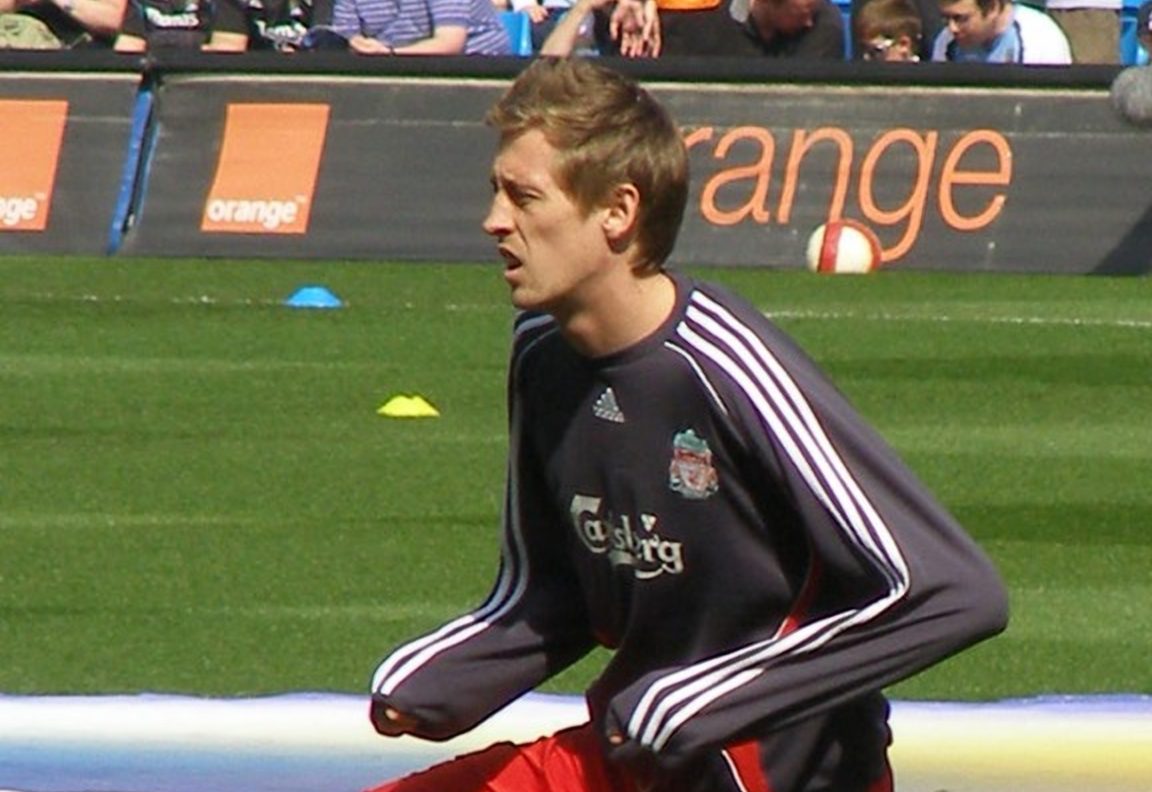
Fifty-three of Peter Crouch’s 108 Premier League goals came from headers. Yet one of the finest finishes of his career was struck with his right foot: a dipping volley from outside the penalty area against Manchester City in March 2012. His height was impossible to ignore. His technique was too often overlooked.
The 6 ft 7 in striker took an unusually winding route to the top, passing through non-league football and Sweden before reaching Liverpool, the Champions League final and two World Cups with England. Later, the dry humour familiar to teammates found a wider audience through books, podcasts and television.
From west London to a Swedish loan
Born in Macclesfield on 30 January 1981, Peter James Crouch spent part of his early childhood in Singapore, where his father worked, before the family returned to England. He grew up in west London and eventually settled with his family in Harrow.
Youth football took him through Brentford and Queens Park Rangers before he joined Tottenham Hotspur’s academy in 1995. He signed professional terms in 1998, but a first-team opening never arrived.
Instead, his introduction to senior football came on loan in 2000, first at Dulwich Hamlet and then at IFK Hässleholm in Sweden. Neither destination offered much glamour. Both gave a young striker experience of playing against adults rather than academy opponents.
That summer, Tottenham sold him to QPR for £60,000. He left without making a competitive first-team appearance.
Finding goals, and a place to belong
At Loftus Road, Crouch finally had regular league football. He scored 10 goals in 42 league appearances during the 2000-01 season, although QPR were relegated from the First Division.
Portsmouth paid £1.5 million for him in July 2001. The move quickly changed his prospects: 18 goals in 37 league games persuaded Aston Villa to spend £5 million on him in March 2002, before his first Portsmouth season was complete.
The Premier League proved a harder place to establish himself. He scored six times in 37 league appearances for Villa and spent part of the 2003-04 campaign on loan at Norwich City. His four goals in 15 league matches helped Norwich towards the First Division title.
Southampton offered a fresh start in July 2004, paying £2 million. Once established in the side, he became their most productive scorer, finishing the league campaign with 12 goals in 27 appearances.
Saints were relegated, but Crouch’s career moved in the opposite direction. In the space of a few months, he made his England debut and secured a transfer to the reigning European champions.
Liverpool: a difficult start, then a bigger stage
Liverpool signed him for £7 million in July 2005. The fee and his unusual physique made him an easy subject for scrutiny, and an 18-match wait for his first goal did little to quieten it.
When the breakthrough finally came against Wigan Athletic in December, the relief was obvious. He scored twice that afternoon and gradually showed why Rafael Benítez had wanted him: he could receive the ball under pressure, bring midfielders into attacks and offer something different against crowded defences.
Crouch helped Liverpool win the FA Cup in 2006 and scored in their Community Shield victory over Chelsea that August. The following spring brought a particularly convincing demonstration of his range: a hat-trick against Arsenal in March 2007, completed with his left foot, head and right foot.
He also appeared as a substitute in the 2007 Champions League final defeat by AC Milan. Across three seasons, he scored 42 goals in 134 competitive appearances, including 22 in 85 league games.
Portsmouth brought him back for £11 million in July 2008. His second spell lasted only a season, but he played all 38 league matches and scored 11 times before another familiar club came calling.
Tottenham and the goals that opened Europe
Crouch returned to Tottenham in July 2009 for a reported £9 million, reuniting with Harry Redknapp, who had also managed him at Southampton and Portsmouth.
This time, he was not an academy prospect waiting outside the first team. He became part of a side pushing into the Premier League’s top four.
His decisive contribution came at Manchester City in May 2010. With Champions League qualification at stake, he headed in the only goal, securing fourth place for Spurs.
The European campaign that followed provided another defining moment. At San Siro in February 2011, Aaron Lennon broke forward and squared the ball for Crouch to score against AC Milan. Tottenham won 1-0 and advanced through the last-16 tie by that aggregate score.
His second Spurs spell produced 12 goals in 73 league appearances. Some mattered considerably more than the bare total suggests.
Stoke, a spectacular volley and a final stop at Burnley
Stoke City paid an initial £10 million in August 2011, then a club-record fee. It became the longest senior stay of his career.
The obvious fit was his aerial presence in a physically demanding team. But his first season also produced that extraordinary volley against Manchester City: controlling a headed return, he struck the dropping ball from distance and sent it over Joe Hart.
Crouch described it as the best goal of his career. He finished the season as Stoke’s Player of the Year.
There were less comfortable moments. A collision with Newcastle defender Fabricio Coloccini in November 2012 knocked out several teeth and required dental treatment. It became another well-documented episode in a career rarely short of unusual stories.
In February 2017, he reached 100 Premier League goals against Everton and briefly revived his Robot Dance celebration. He eventually finished with 108 goals in 468 appearances in the competition, including a record 53 headers.
Across his Stoke career, including their spell in the Championship, he made 225 league appearances and scored 46 goals. He joined Burnley in January 2019, played six league matches without scoring, and announced his retirement on 12 July 2019.
England: 22 goals in 42 appearances
Crouch’s senior England debut came against Colombia on 31 May 2005, following earlier appearances at the Under-20 World Cup and European Under-21 Championship.
His most prolific international year was 2006, when he scored 10 times. Against Hungary that May, he unveiled the Robot Dance, a celebration that became almost as recognisable as his silhouette.
There was serious work behind the comic routine. He scored against Trinidad and Tobago at the 2006 World Cup, helping England secure a place in the knockout rounds, and was selected for a second World Cup in 2010.
His final international appearance came against France on 17 November 2010. He scored that evening, leaving his England record at 22 goals in 42 matches-a substantial return despite never holding an uncontested place in the starting line-up.
More than a target man
At 2.01 metres, Crouch naturally attracted high deliveries. He could win headers, redirect the ball for a strike partner and give defenders an awkward physical problem.
But his value was not confined to the air. He had a secure first touch, could combine through short passes and often played with his back to goal, allowing teammates to move beyond him. His 58 Premier League assists underline that supporting role.
He was not a striker who routinely escaped defenders through pace. Instead, he used positioning, reach and an understanding of the players around him. The volleys and improvised finishes were not departures from his game; they were part of it.
Family life, microphones and television
Crouch married model and television personality Abbey Clancy on 30 June 2011. They have four children: Sophia, Liberty, Johnny and Jack.
Their relationship supplies much of the material for The Therapy Crouch, where the couple discuss domestic habits, disagreements and family life with a comic edge. These are stories they choose to share publicly, rather than a reason to treat every tabloid claim about them as established fact.
His other major audio project, That Peter Crouch Podcast, developed from dressing-room recollections into a substantial second career. The appeal rests on his willingness to explain football’s peculiar routines-and laugh at his own place within them.
His 2018 book, How to Be a Footballer, took a similar approach. Television work has included football punditry and a judging role on the second series of The Masked Dancer.
The Robot helped make him recognisable beyond football. His humour gave audiences a reason to keep listening after the goals stopped.
FAQ
How tall is Peter Crouch?
He is 6 ft 7 in tall, or 2.01 metres.
How many Premier League goals did he score?
He scored 108 goals in 468 appearances, including a competition-record 53 headers.
How many goals did he score for England?
He scored 22 goals in 42 senior internationals and played at the 2006 and 2010 World Cups.
Which clubs did he play for?
His senior clubs included Tottenham, QPR, Portsmouth, Aston Villa, Southampton, Liverpool, Stoke and Burnley, with loans at Dulwich Hamlet, IFK Hässleholm and Norwich.
Who is his wife?
He is married to Abbey Clancy. They have four children and co-host The Therapy Crouch.
When did he retire?
He announced his retirement on 12 July 2019, after finishing his playing career at Burnley.
Photo: Agnieszka Mieszczak, CC BY 2.0, via Wikimedia Commons