A transfer fee of €25,000 changed the course of Edin Džeko’s career. Teplice took a chance on a tall, still-developing forward from Sarajevo, and from there he built one of the broadest club journeys any Bosnian player has managed: the Czech Republic, Germany, England, Italy and Turkey, with goals in all of them.
What followed was not a straight line or a fairy tale. It was a long, durable centre-forward’s career, shaped by adaptation as much as by finishing. Džeko became Bosnia and Herzegovina’s record scorer and most-capped player, won league titles in Germany and England, led the line for some of Europe’s biggest clubs, and kept going well into his late thirties. He has played for Fenerbahçe, Fiorentina and Schalke 04, and retired from international football after the 2026 World Cup.
Growing up in Sarajevo
Edin Džeko was born on March 17, 1986, in Sarajevo, then part of socialist Yugoslavia. His childhood was marked by the Bosnian War and the Siege of Sarajevo, an experience he has spoken about over the years. That background matters in any account of his life, not as decoration, but because it shaped the city he came from and the way he is viewed there.
Football was close by at home too. His father, Midhat Džeko, played professionally, and Edin joined Željezničar’s youth setup in the 1990s. He did not begin as an out-and-out striker. Early on, he was used in midfield, which helps explain something about the player he later became: not just a target for crosses, but a forward comfortable linking play, drifting into channels and finishing with either foot.
As a boy, he admired Andriy Shevchenko. The influence makes sense in hindsight. Džeko’s game was never built on tricks or speed alone. It was about timing, angles, economy and the ability to make a finish look simpler than it was.
Željezničar and the move that opened everything
His senior start at Željezničar was modest. Between 2003 and 2005, he made 40 league appearances and scored five goals. There was promise, but not yet the kind of output that announces a future star.
Then came the move that changed his level. In 2005, Czech club Teplice signed him for a fee widely reported at around €25,000. He spent part of his early period there on loan at Ústí nad Labem, where he played regularly and began to sharpen the scoring instincts that would define the rest of his career.
Back at Teplice, the numbers improved quickly. Across all competitions, he showed enough to attract attention from bigger leagues, and scouts saw what the raw totals only partly captured: a 1.93-metre forward who could score in the air, combine with teammates and finish calmly when chances arrived.
Wolfsburg: the real breakthrough
The decisive jump came in 2007, when VfL Wolfsburg signed him. This was where Edin Džeko stopped looking like a useful prospect and started looking like a top-class Bundesliga striker.
At Wolfsburg, he formed a devastating partnership with Grafite. The 2008-09 season remains the defining chapter of his time in Germany. Wolfsburg won the Bundesliga for the first and only time in club history, and Džeko was central to it, scoring 26 league goals. A season later, he went even bigger individually, finishing as the Bundesliga top scorer with 22 goals in 2009-10 and adding a remarkable haul in all competitions.
By the time he left, his Wolfsburg record stood at 85 goals in 142 competitive matches. More important than the total was the way he scored them. He could dominate centre-backs physically, but he was not stiff or one-dimensional. He peeled off shoulders, attacked the near post, hit early shots and made himself available again and again in the box.
This was also the period when the nickname “Bosnian Diamond” took hold, reportedly first used by commentator Marjan Mijajlović. It stuck because it fit: polished, valuable, and increasingly reliable.
Manchester City and big-pressure football
In January 2011, Manchester City signed Džeko for a fee reported at around £27 million. The club was assembling a squad to win major honours, and his arrival placed him in one of the most competitive dressing rooms in Europe.
His time in England was productive, even if it was not always smooth. Džeko was not the only attacking focal point at City, and he often had to share minutes and rhythm with other high-level forwards. Even so, he delivered important goals and ended his City spell with 72 goals in 189 appearances across all competitions.
The medal list was substantial: the FA Cup in 2010-11, the Premier League in 2011-12 and 2013-14, the Community Shield in 2012 and the League Cup in 2014.
One moment from that era still follows him. In the dramatic final day of the 2011-12 Premier League season, it was Džeko who headed in City’s equaliser against QPR in stoppage time, just before Sergio Agüero scored the title-winning goal. Agüero’s finish became immortal, but Džeko’s intervention was essential. That summed up part of his City story: sometimes not the headline act, often absolutely decisive.
Roma gave him a second peak
When he joined Roma on loan in 2015, with the deal made permanent the following year, it felt at first like a late-career reset. Instead, it became one of the richest scoring spells of his career.
Italian football suited him. Roma used him as a reference point, but not a static one. He could occupy defenders, bring midfield runners into play and still arrive in the right spaces to finish moves himself. In 2016-17, he scored 29 Serie A goals to finish as the division’s top scorer. He also won the Capocannoniere and was named Serie A Footballer of the Year.
Across six seasons with Roma, Džeko scored 119 goals in 260 appearances in all competitions. He became club captain and, for a time, the clear attacking face of the side. One of the standout European nights came in the Champions League, where he helped Roma reach the semi-finals in 2017-18 and scored memorable goals along the way.
By then, he had done something few strikers manage: he had been a major scorer in the Bundesliga, Premier League and Serie A, three leagues with very different rhythms and demands.
Inter and Fenerbahçe
Džeko joined Inter in 2021 and immediately proved useful again. Inter did not sign him for a long-term rebuild; they signed him to contribute now, and he did. In two seasons, he scored 31 goals in 101 appearances, helping the club win the Coppa Italia twice and the Supercoppa Italiana twice.
He also featured prominently in Inter’s run to the 2022-23 Champions League final. Even at that stage of his career, he remained what coaches value in experienced strikers: dependable structure, intelligent movement and goals that still came often enough to matter.
In 2023, he moved to Fenerbahçe. The switch extended his career into another major football culture and another title race. He made an immediate impact in Turkey, scoring regularly and bringing leadership to a squad expected to compete at the top end of the Süper Lig.
Džeko signed with Fiorentina on July 10, 2025, and played for them until January 2026. On January 22, 2026, he transferred to Schalke 04, where he was assigned the number 10 shirt. In August 2026, he agreed to a one-year contract extension, keeping him at the club until June 2027 with a base salary of €900,000 that can rise to €1.3 million annually with performance bonuses. By November 2026, he had made 18 appearances and scored six goals for Schalke across the 2. Bundesliga and Bundesliga.
Bosnia and Herzegovina’s reference point
For the national team, Džeko’s place is clear. He made his debut for Bosnia and Herzegovina in 2007 and went on to become both the country’s most-capped player and its all-time leading scorer.
His biggest international milestone came when Bosnia qualified for the 2014 FIFA World Cup, the first World Cup in the nation’s history. Džeko was central to that campaign and scored Bosnia’s first-ever World Cup goal in the tournament itself, against Iran.
He captained the side for years and remained its attacking reference point well beyond his physical peak. In March 2024, he announced his retirement from international football. He finished with 67 goals in 139 caps, both national records at the time of his retirement.
That record matters not just because of the totals, but because Bosnia and Herzegovina have never had a deeper pool of elite forwards to spread the burden. For a long stretch, if the team needed a goal, the route usually led to Džeko.
How he played
At first glance, the outline seems simple: a tall centre-forward, strong in the air, dangerous in the box. But that only covers part of it.
Džeko was excellent with his back to goal and strong in aerial duels, yet his best football often came from subtler qualities. He adjusted well to different systems, could combine in tight spaces, and finished with a calmness that made him effective across leagues. He was right-footed but comfortable enough on his left to stop defenders showing him one predictable side.
The early shift from midfield to attack left traces in his game. He could drop off, connect moves and then arrive late in scoring positions. That is one reason he aged well as a player. Even when he lost a step, his reading of space still gave him an edge.
Life away from the pitch
Off the pitch, Džeko has generally kept a relatively controlled public profile. He is married to Amra Džeko, and their family life has often appeared in interviews and on social media, though the more private details are best treated carefully. Reports and public posts have long shown them with their children, but there is no need to turn that into gossip.
His connection to Sarajevo has remained a constant theme. So has his standing in Bosnia and Herzegovina, where he is seen not only as a footballer of rare longevity, but as a player whose career carried the country’s name across Europe for nearly two decades.
Commercially, he has been associated with adidas. Beyond that, salary estimates and market-value figures tend to come from third-party databases and can shift quickly, so they are better treated as reported estimates rather than fixed facts.
FAQ
How old is Edin Džeko?
He was born on March 17, 1986.
What is Edin Džeko’s nickname?
He is widely known as the Bosnian Diamond.
Which clubs has Edin Džeko played for?
Željezničar, Teplice, Ústí nad Labem, Wolfsburg, Manchester City, Roma, Inter and Fenerbahçe.
Did Edin Džeko win the Premier League?
Yes. He won the Premier League twice with Manchester City.
Is Edin Džeko Bosnia and Herzegovina’s all-time top scorer?
Yes. He retired from international football as the country’s record scorer.
Has Edin Džeko won the Champions League?
No. He reached the final with Inter in 2023 but did not win the competition.
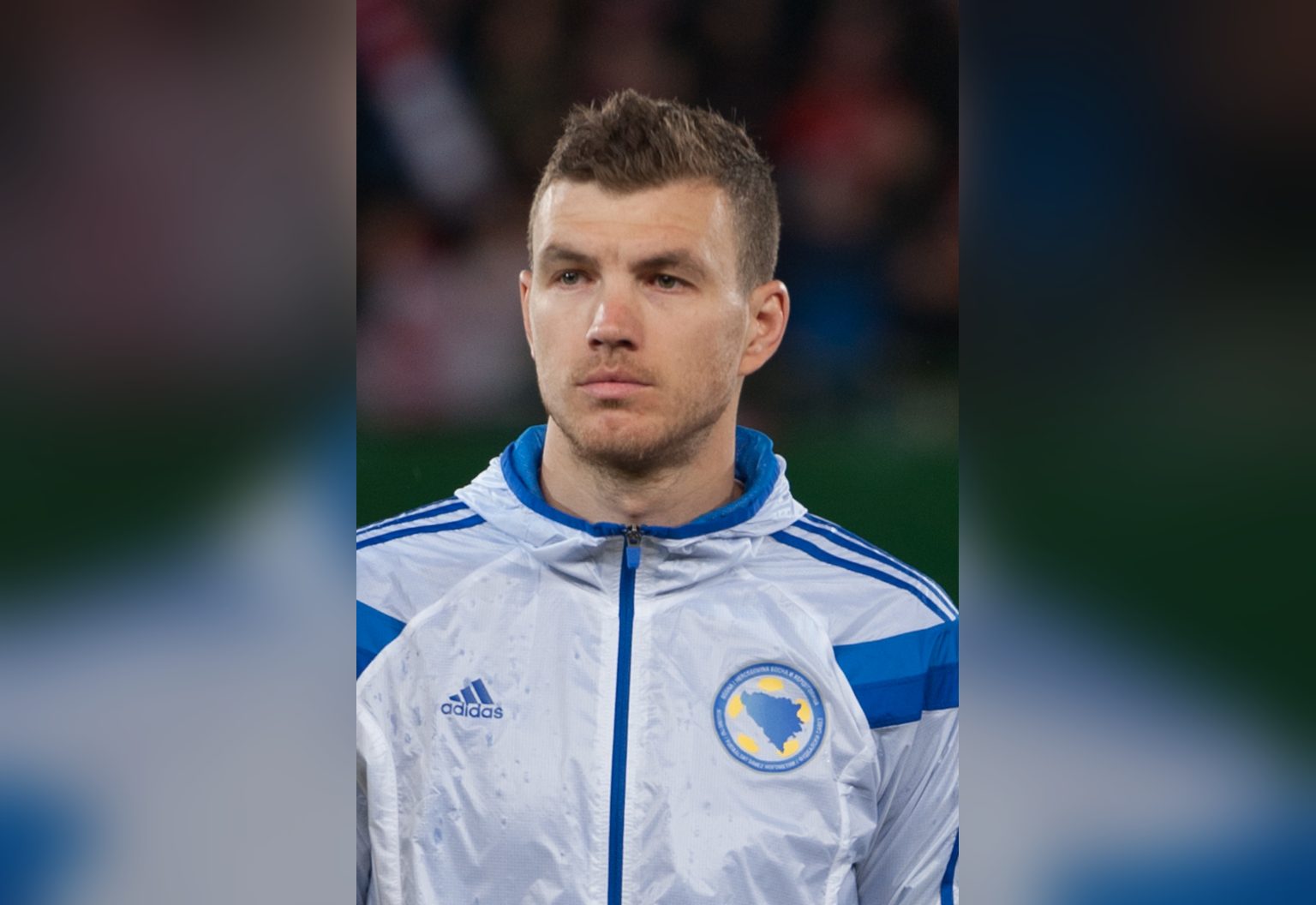
Photo: Ailura, CC BY-SA 3.0 at, via Wikimedia Commons