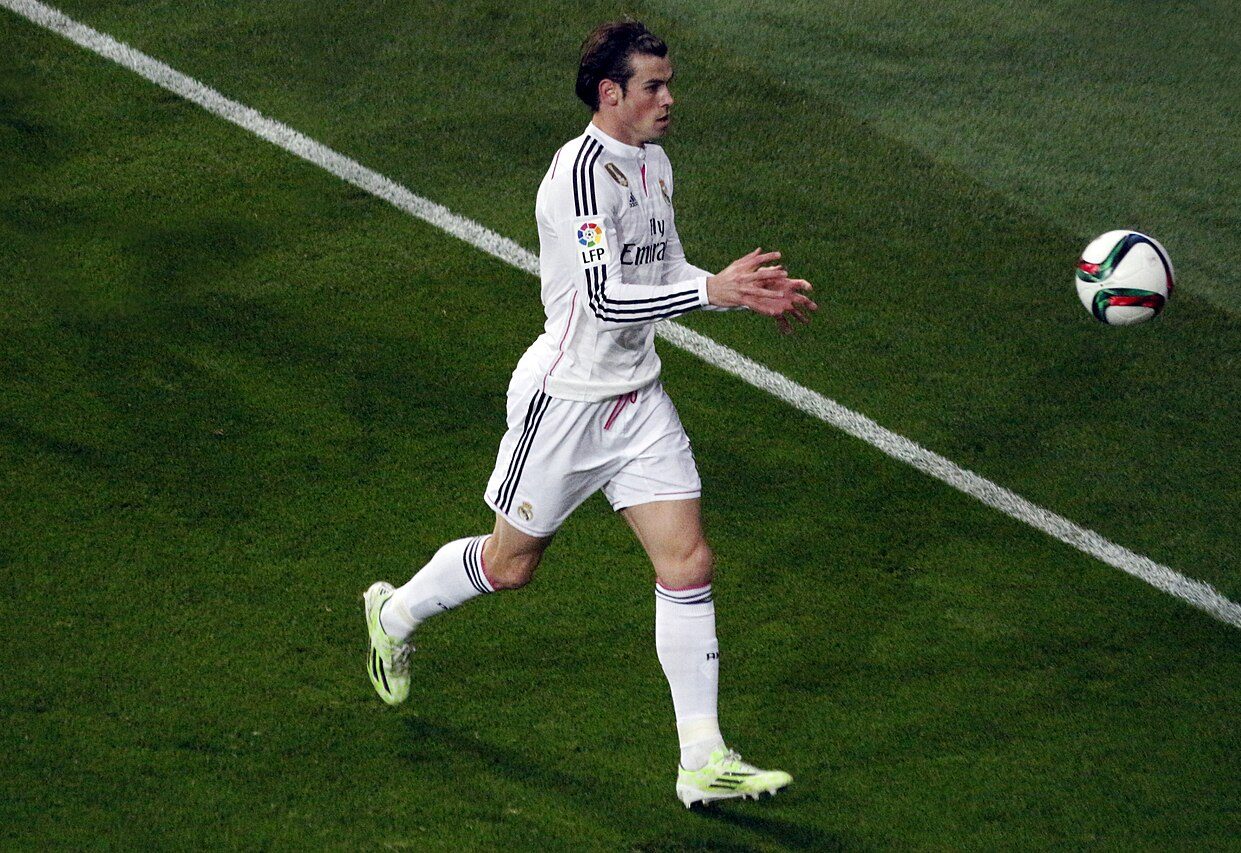
Gareth Bale was still inside his own half when he began the run that decided the 2014 Copa del Rey final. Knocked towards the touchline by Barcelona defender Marc Bartra, he sprinted off the pitch, came back on ahead of his marker and finished past José Manuel Pinto. It was a goal built on the qualities that had taken a Cardiff schoolboy from left-back to the world’s most expensive footballer: speed, strength and a left foot that needed little invitation.
Five Champions League titles followed across his Real Madrid career. For Wales, the achievement was different but equally personal: helping turn qualification for major tournaments from a distant memory into something his generation experienced three times.
Cardiff roots and a Southampton education
Gareth Frank Bale was born in Cardiff on July 16, 1989. His uncle, Chris Pike, played professionally for Cardiff City, while Ryan Giggs was his childhood footballing hero.
At Whitchurch High School, whose former pupils also include Sam Warburton and Geraint Thomas, his athletic ability quickly attracted attention. His PE teacher later recalled introducing special restrictions during football matches: Bale had to play one-touch and could not use his stronger left foot. The much-repeated account of him running 100 metres in 11.4 seconds at 14 also comes from his school days.
Southampton gave that ability a professional setting. After developing in their academy, he made his first-team debut against Millwall on April 17, 2006, aged 16.
A month later, on May 27, he appeared for Wales against Trinidad and Tobago. At 16 years and 315 days, he became the country’s youngest senior international at the time, supplying the cross for Robert Earnshaw’s winning goal.
Initially a left-back, he was already dangerous from free kicks and when advancing down the flank. Southampton supporters saw only 45 first-team appearances and five goals before Tottenham moved for him in May 2007. The deal was worth an initial £5 million, with clauses that could increase the fee.
Tottenham: the full-back moves forward
His rise in north London was not immediate. Injuries interrupted his early progress, and an awkward statistic followed him around: his first 24 Premier League appearances for Tottenham passed without a victory.
The breakthrough came as he moved further up the pitch. With less defensive ground to protect, he could attack the space behind opposing full-backs rather than begin every run from deep.
Two Champions League meetings with Inter Milan in 2010 made the change impossible to miss. At San Siro, Spurs were four goals down and reduced to ten men when Bale scored a second-half hat-trick in a 4-3 defeat. In the return fixture, his repeated runs past Maicon helped Tottenham win 3-1.
He was voted PFA Players’ Player of the Year for 2010-11. By his final season before leaving for Spain, he was operating with greater freedom, moving infield and deciding matches with shots from distance.
His 21 Premier League goals in 2012-13 brought another PFA Players’ Player of the Year award, alongside the PFA Young Player, FWA Footballer and Premier League Player of the Season honours.
That first Tottenham spell produced 203 appearances and 55 goals in all competitions. Real Madrid signed him in September 2013 for a reported £85.1 million, then a world-record fee.
Real Madrid: decisive goals on the biggest nights
Madrid paired Bale with Cristiano Ronaldo and Karim Benzema in the attacking trio known as “BBC”. Each offered something different; the Welshman supplied direct running, aerial power and the ability to turn a loose ball into a counterattack.
His first season ended with two defining contributions. After the Copa del Rey winner against Barcelona, he headed Madrid ahead in extra time against Atlético Madrid in the 2014 Champions League final. The eventual 4-1 victory secured the club’s tenth European Cup.
Success in Spain ran alongside an increasingly significant Wales career. At Euro 2016, he scored in all three group matches as his country reached the semi-finals of its first major tournament since the 1958 World Cup. His free kick against Slovakia was Wales’ first goal at a major finals in 58 years.
Back at Madrid, European titles followed in 2016 and 2017. Then came Kyiv.
Introduced from the bench against Liverpool in the 2018 Champions League final, Bale met Marcelo’s cross with an overhead kick that put Madrid 2-1 ahead. A second goal, from a long-range shot mishandled by Loris Karius, completed a 3-1 win and earned him the final’s man-of-the-match award.
The later Madrid years were less settled. Injuries disrupted his availability, and his place in the team diminished. His relationship with sections of the Spanish media and support became strained, with recurring criticism of his perceived priorities and integration.
In November 2019, after Wales qualified for the European Championship, he celebrated with teammates behind a flag reading “Wales. Golf. Madrid. In that order.” The slogan drew criticism in Spain. It was a public controversy, not proof of what he did or did not care about.
A Tottenham return and a final European medal
A season-long loan brought him back to Spurs in 2020-21. He was no longer the player who could repeatedly overwhelm opponents through sheer acceleration, but his finishing remained effective: 16 goals in 34 appearances across all competitions.
That return took his combined Tottenham record to 237 appearances and 71 goals, including 53 goals in 166 Premier League matches.
He returned to Madrid for the final year of his contract and was part of the squad that won the 2021-22 Champions League, although he did not play in the final. It was his fifth winner’s medal in the competition.
His Madrid career ended with 106 goals in 258 competitive appearances, alongside three La Liga titles, one Copa del Rey, three Spanish Super Cups, three UEFA Super Cups and four FIFA Club World Cups.
The limited involvement at the end should not obscure the earlier contribution. Several of Madrid’s most important finals had turned on his goals.
Los Angeles, a World Cup and retirement
Bale signed for Los Angeles FC in June 2022 and made his debut the following month. His American spell lasted just 14 appearances, but it contained one final intervention.
In the 2022 MLS Cup final against Philadelphia Union, he headed an equaliser deep into extra-time stoppage time to make it 3-3. LAFC won the penalty shootout. He finished his club career with three goals for the team and another championship.
Wales provided the closing international chapter. Having appeared at Euro 2020, played in 2021, he helped his country qualify for the 2022 World Cup-their first in 64 years. In Qatar, his penalty against the United States secured a 1-1 draw, though Wales went out in the group stage.
On January 9, 2023, he announced his retirement from club and international football. He left Wales with 111 caps and 41 goals, retiring as the men’s team’s appearance record-holder and leading scorer.
How Gareth Bale played
At his most effective, Bale made defenders retreat before he had even received the ball. Leave space behind and he could outrun them; stand off and he could shoot.
His powerful left foot supplied free kicks, dipping strikes and driven crosses. At 1.86 metres, he was also a serious aerial threat, particularly when arriving at the far post.
The progression from full-back to winger and then a more central forward reflected more than a positional change. Early in his career, long runs created the danger. Later, timing, movement and finishing allowed him to remain effective when those runs became less frequent.
Family, golf and life beyond football
Bale married his long-term partner, Emma Rhys-Jones, in 2019. They have four children and have generally kept family life away from the attention attached to his playing career.
Golf, by contrast, has never been a secret. It became an easy shorthand during the Madrid disputes, but his interest continued beyond football. Shortly after retiring, he competed alongside professional golfers at the 2023 AT&T Pebble Beach Pro-Am-a different setting for someone accustomed to packed stadiums, with rather more time between shots.
His charitable work has also been publicly documented. During the COVID-19 pandemic, Bale and his wife donated £500,000 to the Cardiff & Vale Health Charity. He was appointed MBE in 2022 for services to football and charity.
The public image could seem contradictory: a reserved family man whose most recognisable club moments were spectacular, and a player criticised over his priorities who repeatedly delivered for Wales. His career makes more sense through those performances than through the arguments around him.
FAQ
How many Champions League titles did Gareth Bale win?
He won five with Real Madrid: in 2014, 2016, 2017, 2018 and 2022.
How many goals did he score for Real Madrid?
He scored 106 goals in 258 competitive appearances, including 81 goals in 176 La Liga matches.
What was his transfer fee to Real Madrid?
The September 2013 transfer was widely reported at £85.1 million, a world record at the time.
What was his Wales record?
He retired with 41 goals in 111 senior appearances, holding both men’s national-team records when he stopped playing.
When did he retire?
He announced his retirement from club and international football on January 9, 2023.
Who is Gareth Bale’s wife?
He married Emma Rhys-Jones in 2019. The couple have four children.
Photo: Anish Morarji from St Albans, England, CC BY 2.0, via Wikimedia Commons