Rejection came early. French academies looked at Antoine Griezmann, saw a slight teenager, and passed. Real Sociedad saw something else.
Born in Mâcon on March 21, 1991, Griezmann grew up far from the usual script of a French star. He spent his earliest football years with local sides Entente Charnay et Mâcon and then UF Mâconnais, developing in Burgundy before a youth tournament changed his direction. Scouts from Real Sociedad spotted him, and in 2005 he crossed the border into Spain to join the Basque club’s academy.
That move shaped almost everything that followed. While many French internationals came through Clairefontaine or a Ligue 1 pathway, Griezmann built himself in San Sebastián. He learned the game in a different football culture, one that sharpened his movement, his combination play and his feel for space. He had supported Lyon as a boy and, by his own account, once dreamed of being a goalkeeper. Instead, he became one of the most intelligent roaming attackers of his generation.
His family background also stretches beyond France. Griezmann has Portuguese roots through his mother’s side, and his maternal grandfather, Amaro Lopes, was a footballer.
Real Sociedad gave him his opening
His senior debut arrived in the Copa del Rey in September 2009, and his league breakthrough followed quickly. That season, still a teenager, he helped Real Sociedad win the Segunda División title and return to La Liga.
Over five senior seasons with the club, he made 202 competitive appearances and scored 52 goals. In La Liga alone, he hit 16 goals in his final season there, a return that confirmed he was ready for a bigger stage. He was not a classic touchline winger and not quite a fixed centre-forward either. He drifted, linked play, arrived late into the box and found ways to influence matches without needing constant possession.
By the time he left San Sebastián, the outline of the player was clear: left-footed, tactically sharp and able to play across the front line or just behind it.
Atlético Madrid turned him into a leading forward
Atlético Madrid signed him in the summer of 2014 after activating his release clause, reported at €30 million. Diego Simeone’s side had just won La Liga and reached a Champions League final. Griezmann arrived at a club already hardened by big nights, and he adapted quickly.
His first season brought 25 goals in all competitions. The next one brought even more. In 2015-16 he scored 32 times, finished as Atlético’s top scorer and played a central role in another run to the Champions League final. Atlético lost that final to Real Madrid on penalties, but Griezmann’s standing had changed. He was no longer a promising attacker from Real Sociedad. He was one of the key forwards in Europe.
The silverware followed in the years around that peak. Atlético won the UEFA Europa League in 2017-18 and then the UEFA Super Cup in 2018. Griezmann scored twice in the Europa League final against Marseille, a performance that summed up his game at its best: sharp movement, calm finishing, relentless work without the ball.
He also came close to the biggest individual prizes without quite taking them. He finished third in the Ballon d’Or voting in both 2016 and 2018, and third in The Best FIFA Men’s Player award in 2016. Those placings reflected how highly he was regarded in that period.
Across two spells at Atlético, he became one of the defining players of the Simeone era. In January 2024, he overtook Luis Aragonés to become the club’s all-time top scorer in official matches. That was a significant landmark at a club with a long history and plenty of great forwards.
Barcelona never quite felt like a natural fit
In July 2019, Barcelona signed Griezmann after paying his €120 million release clause. It was one of the biggest transfers of that summer, but the fit was awkward from the start.
Atlético had previously disputed the timing of Barcelona’s approach and argued that a higher clause should have applied earlier in the window. The disagreement became part of the background noise around the move, though the transfer itself went through.
On the pitch, there were moments of quality but not the sustained authority he had shown in Madrid. He scored 35 goals in 102 official matches for Barcelona and won the Copa del Rey in 2020-21. Even so, his role often looked unsettled. He was sharing attacking spaces with Lionel Messi, adjusting to a different rhythm, and rarely seemed as free as he had at Atlético.
That does not make the spell a failure in simple terms. He contributed, won a trophy and remained productive enough. But compared with the clarity of his Atlético years, Barcelona felt like a detour rather than a perfect match.
Back in Madrid, the connection returned
Griezmann returned to Atlético in 2021, initially on loan, before the move was made permanent in 2022. Back under Simeone, the old understanding resurfaced.
He dropped deeper at times, created more, and still scored enough to keep adding to his totals. The second spell was not just a nostalgic reunion. It broadened the picture of him. He was no longer only the finisher making diagonal runs beyond defenders; he had become even more of a connector, a playmaker-forward who could knit together an attack and still decide matches himself.
By the time he moved on, he had made 435 competitive appearances for Atlético and scored 197 goals for the club in official matches.
France career: trophies, heartbreak and remarkable consistency
His senior France debut came in March 2014 against the Netherlands. Within two years, he had become central to Didier Deschamps’ team.
Euro 2016, played on home soil, was the tournament that pushed him fully into the international spotlight. France reached the final, where they lost to Portugal after extra time, but Griezmann finished as the competition’s top scorer with six goals and was named Player of the Tournament. He had carried the attack for long stretches.
Then came the biggest prize. At the 2018 FIFA World Cup, he scored four goals as France won the tournament in Russia. He converted a penalty in the final against Croatia and was one of the side’s most influential players throughout the campaign, combining goals with set-piece delivery, pressing and link play.
He later added the UEFA Nations League in 2021, and he was part of the France squad that reached the 2022 World Cup final. In Qatar, his role shifted again. Deschamps used him in a deeper creative position, and he responded with some of the most complete all-round displays of his international career.
Griezmann retired from international football in 2024. He finished with 137 caps and 44 goals for France, along with a reputation as one of the most selfless and tactically adaptable attackers the national side has had. He also set a France record by appearing in 84 consecutive internationals between 2017 and 2023.
There was one early blemish in his youth career. In 2012, he was suspended by the French federation, along with several other youth internationals, after leaving camp without permission.
How he played
At 1.76 metres, Griezmann never relied on physical dominance. His strengths were timing, awareness and economy.
He is naturally left-footed, but what really defined him was how he interpreted space. He could start as a second striker, drift into midfield, pull wide, or arrive unseen in the penalty area. Coaches valued him because he made systems work. He pressed seriously, tracked runners, linked midfield to attack and still produced goals.
That versatility sometimes made him harder to categorize than a pure No. 9 or a classic winger. It also made him easier to build around. At his best, he was the sort of forward who improved the players around him while still carrying his own numbers.
Life away from football
Off the pitch, Griezmann has long projected a more playful public image than many elite forwards. He is married to Erika Choperena, and they have three children. One family detail is often mentioned because it is so unusual: all three children were born on April 8, each in a different year.
He has also spoken about his love of horses and equestrian sport. That interest sits a little outside the usual footballer profile and gives his off-field life a distinct note.
Some of the lighter details around him have stuck over the years. He voiced Superman in the French version of The LEGO Batman Movie. He is also known for a tattoo in Arabic based on a line often translated as: “Make your life a dream, and a dream a reality.”
One of the most serious moments connected to his family came in November 2015, when his sister Maud survived the Bataclan attack in Paris. Griezmann was on international duty that night while France played Germany at the Stade de France.
His nicknames have included Grizi and, most famously, Le Petit Prince, a label that suits both his slight frame and the imagination in his game.
FAQ
What position does Antoine Griezmann play?
He has played as a forward, second striker, attacking midfielder and wide attacker, usually in a free-roaming role.
How many goals did Antoine Griezmann score for France?
He scored 44 goals in 137 senior international appearances.
Did Antoine Griezmann win the World Cup?
Yes. He won the 2018 FIFA World Cup with France.
Which club did Antoine Griezmann play for the longest?
Atlético Madrid was the defining club of his career, across two spells.
Is Antoine Griezmann Atlético Madrid’s all-time top scorer?
Yes. He became Atlético’s top scorer in official matches in 2024.
Who is Antoine Griezmann’s wife?
He is married to Erika Choperena.
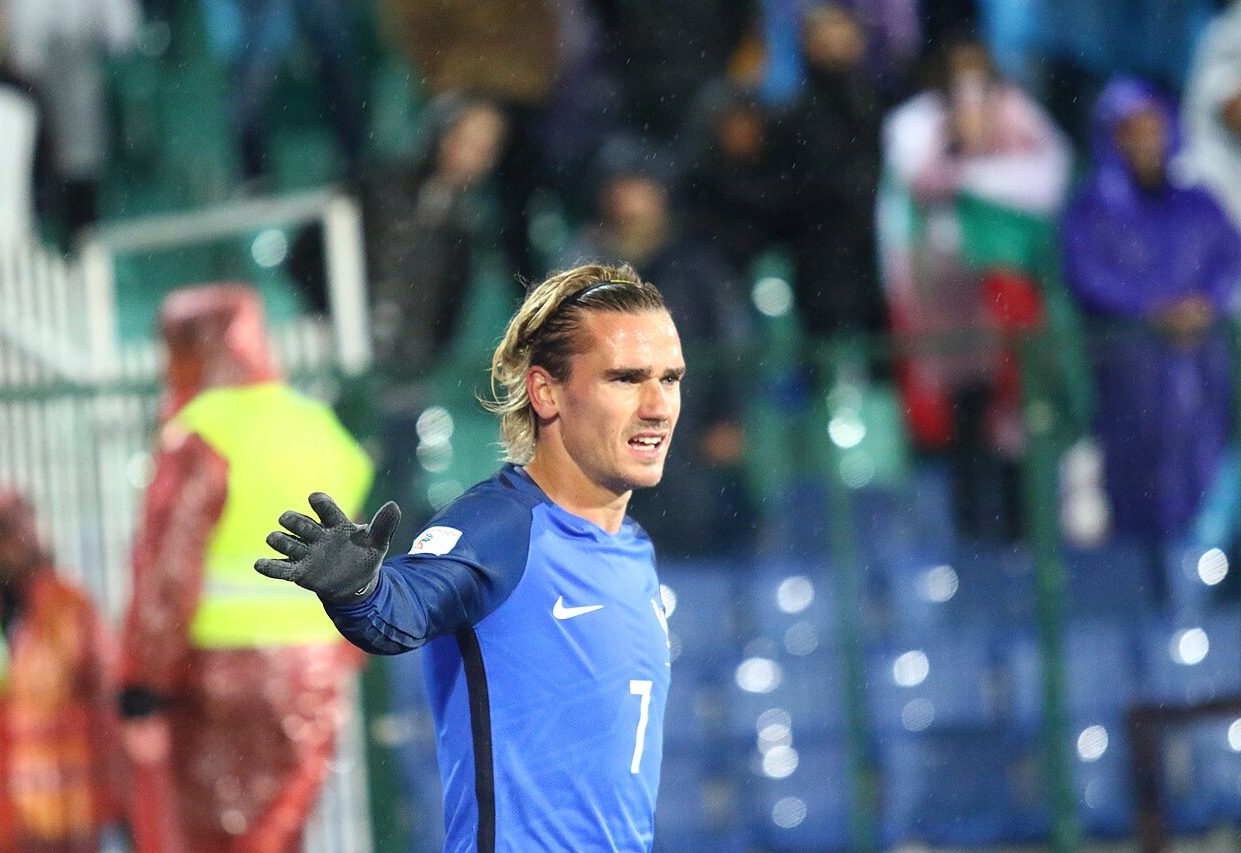
Photo: Biser Todorov ( User:Biso ) from Sofia, Bulgaria, CC BY-SA 2.0, via Wikimedia Commons