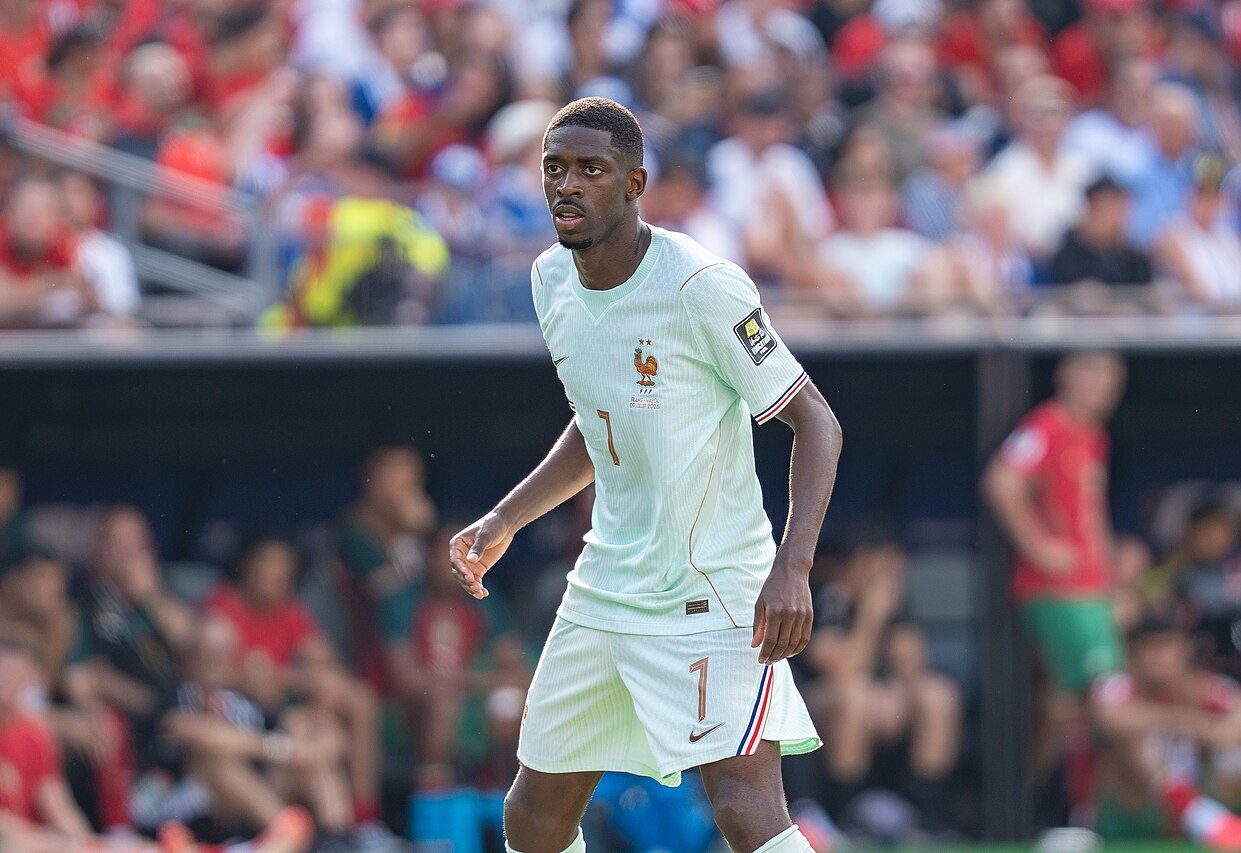
A hat-trick against Nantes, a €100 million-plus transfer before his 21st birthday, a World Cup winner’s medal with France: Ousmane Dembele’s career has rarely moved in a straight line. It has surged instead, driven by speed, improvisation and that unusual ability to play with either foot as if there were no weaker side at all.
Born in Vernon, in the Eure department of France, on May 15, 1997, Masour Ousmane Dembele grew up in a family with West African roots. His mother is of Mauritanian-Senegalese background and his father has Malian heritage. Football started locally, first at Madeleine Evreux and then at Evreux, before Rennes brought him into one of the country’s best academy systems.
That climb was quick. At Rennes, Dembele sharpened the qualities that would define him later: close control in tight spaces, sudden changes of direction and a willingness to attack defenders one-on-one. His youth years also included futsal, often cited as an influence on the way he manipulates the ball and escapes pressure.
Rennes gave him the stage
Before Ligue 1 knew his name, Rennes II did. Dembele scored 13 goals in 22 appearances for the reserve side, enough to make it clear he would not stay there long.
His senior debut for Rennes came on November 6, 2015, in Ligue 1 against Angers. What followed was not a slow introduction but a breakout. In the 2015-16 season, he scored 12 league goals in 26 appearances, a remarkable return for a teenager in his first top-flight campaign. On March 6, 2016, he hit the first hat-trick of his professional career in a 4-1 win over Nantes.
Rennes had developed gifted attackers before, but Dembele brought a different kind of unpredictability. He could go outside or inside, cross or shoot with either foot, and defenders often looked unsure which angle they were supposed to close. By the end of that season, he had been named Ligue 1 Young Player of the Year.
One season at Dortmund was enough
Borussia Dortmund moved fast in the summer of 2016, signing him from Rennes. The fee was widely reported at around €15 million, a figure that soon looked modest.
Dembele needed little time to settle in Germany. In his only season at Dortmund, he made 49 appearances in all competitions, scored 10 goals and supplied 21 assists. Those numbers tell the story better than a simple goal tally. He was not just finishing moves; he was creating them constantly.
There were standout moments all year. In the Champions League, he became the first player since Opta began recording the data to provide three assists in a single match while still a teenager, doing so against Legia Warsaw. Domestically, he helped Dortmund win the 2016-17 DFB-Pokal, scoring in the final against Eintracht Frankfurt.
By the end of the campaign, he had been named Bundesliga Rookie of the Season and included in the Bundesliga Team of the Season. More importantly, he had shown he could produce at a higher level without losing the spontaneity that made him so difficult to contain.
Barcelona: huge fee, bright flashes, interrupted rhythm
The next transfer changed the scale of everything around him. In August 2017, Barcelona signed Dembele from Dortmund for an initial €105 million, with add-ons that could take the deal to around €145 million. At the time, it made him one of the most expensive players in football history.
His years in Spain were productive, but rarely smooth. He debuted for Barcelona in the Supercopa de Espana and soon suffered a serious hamstring injury that disrupted his first season. That pattern, flashes of brilliance interrupted by physical setbacks, would shape much of his time at the club.
Even so, the medal count was substantial. With Barcelona, he won three La Liga titles, two Copa del Rey trophies and two Supercopa de Espana titles. Across his spell there, he played 185 matches in all competitions, scored 40 goals and provided 43 assists.
There were stretches when he looked close to unplayable. In the 2021-22 league season, he finished as La Liga’s top assist provider with 13, a reminder that his game has always been about more than dribbling or highlight-reel moments. At his best, he speeds attacks up, opens the pitch and spots passes others do not.
The Barcelona period also brought scrutiny away from the pitch. Reports in the Spanish press described disciplinary fines earlier in his time at the club, often linked to lateness or routine breaches rather than anything more serious. Claims that fatherhood helped him settle are best treated as interpretation rather than hard fact, but those close to the club did often describe him as more settled in the later part of his Barcelona career.
Back to France with Paris Saint-Germain
In 2023, Dembele returned to Ligue 1 when Paris Saint-Germain signed him from Barcelona. The transfer fee was widely reported at just over €50 million, far below the sum Barcelona had paid six years earlier.
The move made football sense. PSG were getting a forward who already knew elite-level pressure, could play wide or centrally, and had matured tactically since his first spell in France. He took the number 10 shirt and quickly became one of the team’s main attacking references.
Dembele has been a major PSG player since his arrival in 2023, winning the 2025 and 2026 UEFA Champions League titles and the 2025 Ballon d’Or. Reports linked him with a contract extension. According to L’Equipe in August 2026, he was reportedly close to agreeing fresh terms to extend his deal until 2030, while the same outlet also reported interest from Saudi Pro League clubs. Those remained reports, not confirmed outcomes.
France career: a World Cup winner with more than one tournament cycle
Dembele made his France debut on September 1, 2016, against Italy. He arrived in the national team young, but not as a novelty pick. By then, he had already broken through at Rennes and earned his move to Dortmund.
The defining early chapter came at the 2018 FIFA World Cup. Dembele was part of Didier Deschamps’ squad as France won the tournament in Russia, giving him the biggest team honor in the sport before he had reached his peak years.
He was also part of the France squad that reached the 2022 World Cup final, where they finished runners-up to Argentina. Between those tournaments, and at the European Championship, he remained a regular option for France because his profile is unusual even at international level. Few attackers can receive wide, beat a man on either side and still deliver the final ball cleanly with both feet.
Dembele has built a substantial France career across multiple major tournaments. By 2026, he had earned 71 caps and scored 13 goals. He won the 2018 World Cup, was a runner-up in 2022, and played in the 2026 World Cup, where he scored a first-half hat-trick against Norway.
Why defenders hate facing him
The simplest description of Ousmane Dembele is also the most accurate: he is a two-footed wide forward who creates disorder.
That matters because defenders usually rely on cues. Show him outside. Force him onto his weaker foot. Delay him until support arrives. Dembele removes some of those solutions. He can dribble left or right, cross early, cut back, shoot from either side and accelerate away in the first few steps.
He has played mostly as a right winger, but he is not fixed there. Coaches have used him on the left, as a second striker and in more central attacking roles. Wherever he starts, the pattern is familiar. He receives, drives, commits defenders and turns instability into a chance.
At his best, he is not a metronomic possession winger. He is a risk-taker. Some moves break down. Others split a game open.
Off the pitch: family, faith and a serious controversy
Away from football, Dembele married Rima Edbouche in a private, traditional Moroccan ceremony in December 2021. The couple had a daughter in 2022. He publicly nicknamed her “the Catalan” because she was born in Barcelona.
He is Muslim and has observed Ramadan during his career. His family life has become more visible only in small glimpses; Dembele has generally kept his private world private.
One off-field episode, however, was very public. In 2021, a video circulated showing Dembele making offensive remarks about Japanese technicians in a hotel room while he was on club duty. The footage drew criticism and remains the most serious documented controversy of his career away from the pitch.
There have also been legal and contract-related reports around him. Goal reported that his agent, Moussa Sissoko, was considering legal action involving Barcelona over financial matters linked to Dembele’s transfer situation. Separately, L’Equipe reported details of salary discussions at PSG. Both belong in the category of published reporting rather than confirmed final outcomes.
His wife, Rima Edbouche, has also been reported to run a modest fashion label, Razalae.
FAQ
How old is Ousmane Dembele?
He was born on May 15, 1997.
What club does Ousmane Dembele play for?
He plays for Paris Saint-Germain.
Has Ousmane Dembele won the World Cup?
Yes. He was part of France’s 2018 World Cup-winning squad.
What position does Ousmane Dembele play?
He is mainly a forward or winger, most often used on the right.
Is Ousmane Dembele really two-footed?
Yes. That is one of the defining traits of his game.
Who is Ousmane Dembele’s wife?
He is married to Rima Edbouche.
Photo: Bryan Berlin, CC BY-SA 4.0, via Wikimedia Commons