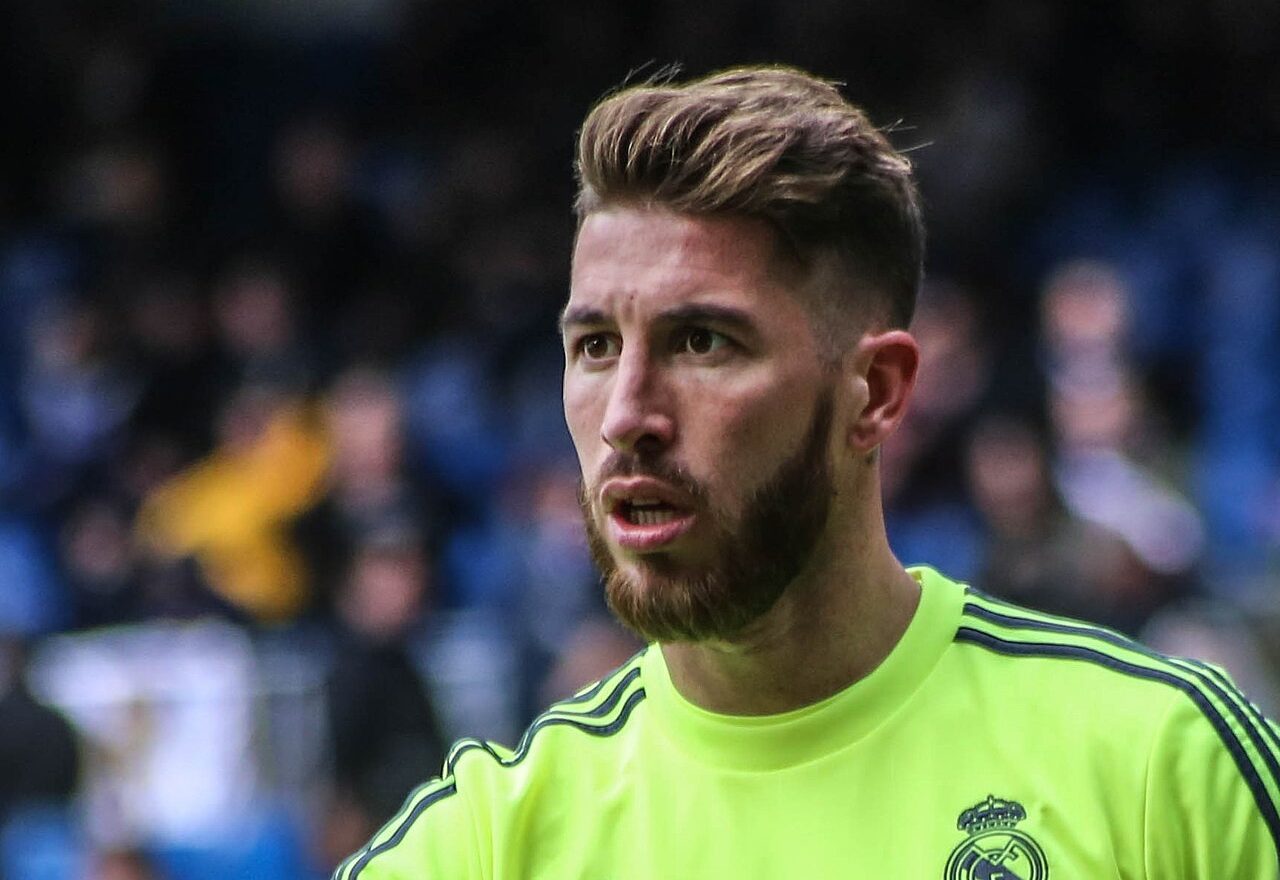
Ninety-three minutes had gone in Lisbon when Sergio Ramos changed both a final and, in some ways, his own legend. The header against Atlético Madrid in the 2014 Champions League final did more than keep Real Madrid alive; it became the image that followed him for the rest of his career, right down to the No. 93 shirt he later chose at Monterrey.
That one moment fits the wider story. Ramos was a defender, but never a quiet one. He scored like a set-piece striker, defended with edge, collected medals in bulk and, just as often, found himself at the center of arguments. Across spells with Sevilla, Real Madrid, Paris Saint-Germain and Monterrey, he built one of the most eventful careers of his generation.
From Camas to Sevilla’s first team
Sergio Ramos García was born on March 30, 1986, in Camas, just outside Seville. He began at local side Camas CF before joining Sevilla’s academy, where his path into elite football took shape. One detail from those early years stayed with him: he started out as a forward. Later, when he became known as a goalscoring defender, that background made perfect sense.
His senior breakthrough came young. Ramos made his first-team debut for Sevilla in February 2004 and quickly stood out for his athleticism, aggression and confidence on the ball. He was still a teenager, but he did not play like one. During his first spell with Sevilla, he made 50 senior appearances in all competitions and scored three goals before Europe’s biggest clubs came calling.
The Real Madrid years that defined him
Real Madrid signed Ramos in the summer of 2005 for around €27 million, a huge fee for a defender of his age at the time. He arrived first as a right-back, raw but gifted, and over the years developed into a commanding centre-back and eventually club captain.
This was the long central chapter of his career: 16 seasons, 671 appearances and 101 goals for Madrid in all competitions. For a central defender, those numbers remain extraordinary. He was never simply a marker or tackler. He attacked set pieces, took penalties at times and had a knack for scoring in matches that mattered.
The trophy list tells its own story. With Madrid, Ramos won five La Liga titles, two Copas del Rey, four Spanish Super Cups, four Champions Leagues, three UEFA Super Cups and four Club World Cups. He was part of title-winning sides under different managers and in different tactical setups, which says something about his adaptability as much as his durability.
Still, some seasons and moments stand above the rest. The equalizer in the 2014 Champions League final is the obvious one, not just because of the timing but because it unlocked “La Décima,” the club’s long pursuit of a 10th European Cup. Madrid went on to win 4-1 after extra time, and Ramos’ header became one of the defining images of the competition.
He also captained Madrid through the era in which they won the Champions League three times in a row from 2016 to 2018. That period cemented his place among the club’s most important modern leaders. He was not always elegant in the classical sense, but he was forceful, decisive and impossible to ignore.
There were records, too. Ramos became the first captain to lead a team to back-to-back Champions League titles in the modern era. He was also remarkably consistent as a scorer across league seasons, finding the net in 17 consecutive La Liga calendar years from 2004 to 2020.
A shorter spell in Paris
When his Madrid contract ended, Ramos joined Paris Saint-Germain in July 2021 on a free transfer. The move brought a change of league and a fresh challenge, though the start was slowed by injuries. Even so, once fit, he added experience and authority to PSG’s back line.
His time in France lasted two seasons. Ramos made 58 appearances and scored six goals for the club, winning Ligue 1 twice and the Trophée des Champions once. Reports at the time placed his salary at around €6 million net per season, though contract figures were never always presented identically across outlets.
The Paris spell did not carry the same emotional weight as Madrid, but it did show that his game still traveled: aerial strength, front-foot defending, leadership and a threat in both penalty areas.
Back to Sevilla, then on to Monterrey
In September 2023, Ramos returned to Sevilla, the club where his senior career had begun. It was a homecoming with obvious symbolism after 18 years away. He came back not as a prospect, but as a World Cup winner, former Real Madrid captain and one of Spain’s most decorated defenders.
Reports in Spain said he accepted a far lower salary than he had earned elsewhere, with figures around €2 million gross per season widely cited. More important than the money was the meaning of the move. For Sevilla supporters, it was a complicated return because of his Real Madrid history, but also a notable one: a local player coming home at the end of a long journey.
The next chapter took him outside Europe. Ramos joined Monterrey on a free transfer and again chose shirt number 93, a direct nod to Lisbon. The move underlined something that had followed him throughout his career: wherever he went, the old moments came with him.
During his spell with Monterrey in 2025, Ramos made 34 appearances across all competitions and scored eight goals. He left the club following their Apertura playoff elimination and became a free agent after December 2025. His market value during this period was estimated to be between 1 million and 4.3 million euros.
Spain: from teenage debutant to record cap-holder
Ramos made his Spain debut in 2005 and went on to become the national team’s most-capped player with 180 appearances. He also scored 23 goals, a striking return for a defender.
Before the senior side, he had already won the UEFA European Under-19 Championship with Spain in 2004. Then came the golden era. Ramos was part of the team that won Euro 2008, the 2010 World Cup and Euro 2012, a run that placed Spain among the great international sides of the modern game.
He was there for the rise from talented contenders to tournament specialists. At first he played largely as a right-back; later he moved inside and formed a high-level centre-back partnership with Gerard Piqué. Spain also finished third at the 2009 Confederations Cup and runners-up in 2013.
One unusual detail in his international scoring record often gets mentioned: despite 23 goals for Spain, he did not score in open play during a major tournament finals campaign. His impact, though, was never measured only in goals. He brought authority, recovery pace, aggression and a strong mentality to a side more often associated with technical control.
How Sergio Ramos played
At his best, Sergio Ramos was a defender of contradictions in the best sense. He could be rash, but also decisive. He was combative, yet technically comfortable. He loved a duel, attacked the ball in the air and rarely hid in big moments.
Early in his career, his speed and crossing made him a natural right-back. As he matured, he shifted into the middle, where his reading of danger, timing in the air and personality became even more valuable. He could also fill in as a defensive midfielder when needed.
Then there was the scoring. Few defenders have matched his output over such a long period. Set pieces were the obvious route, but not the only one. He attacked second balls, arrived late into the area and struck penalties with unusual calm for a centre-back.
The other side of the profile was disciplinary. Ramos holds the La Liga record for red cards, with 20 in the competition, and his overall career total climbed to 30 by early 2025. That number is not a footnote. It is part of the full picture: a player whose aggression often gave him an edge, but sometimes tipped over it.
Flashpoints and controversy
No honest profile of Ramos leaves out the confrontations. He played on the edge for most of his career, and sometimes beyond it.
One of the most remembered incidents came in a Clásico in 2010, when he was sent off late in a heavy defeat to Barcelona after a foul on Lionel Messi and a shove on Carles Puyol. In 2013, he received a four-match ban after comments made toward a referee.
The 2018 Champions League final against Liverpool brought another moment that still gets debated. Ramos’ challenge on Mohamed Salah led to the forward leaving the match injured. It became one of the most discussed incidents of his career, with arguments over intent continuing long after the final whistle. What can be said clearly is that the challenge shaped the game and added another controversial entry to his record.
Honors and individual recognition
The team trophies are extensive, but Ramos also collected individual honors over a long stretch. He was named in the FIFA FIFPRO World 11 eleven times, first in 2008 and then every year from 2011 through 2020. He also featured repeatedly in UEFA’s annual best XIs and Champions League teams of the season.
For Spain, he was named in the 2010 World Cup Dream Team and the Euro 2012 Team of the Tournament. At club level, he won the Golden Ball at the 2014 FIFA Club World Cup.
By the time his career moved into its later stages, he had passed 1,000 senior appearances, a mark that underlines both his longevity and his importance to the teams he played for.
Life away from football
Off the pitch, Ramos has long had a public profile that extends beyond football. He married Spanish TV presenter Pilar Rubio in June 2019, and the couple have four sons. Because their family life has often been covered in Spanish media, it is one of the more visible parts of his private world, though it still sits best as background rather than centerpiece.
He is also closely associated with horses. Ramos has owned and bred horses through his estate near Seville, and equestrian life has been a genuine long-term interest rather than a passing celebrity hobby. That side of him fits the Andalusian roots that have always remained visible in his public image, alongside his well-known affection for flamenco and bullfighting culture.
Commercially, he has worked with major brands including Nike, Hugo Boss, Pepsi and Gatorade, and he has also been involved in charitable work, including with UNICEF.
One lighter moment has followed him almost as long as any medal: during Real Madrid’s 2011 Copa del Rey celebrations, he dropped the trophy from the top of the team bus. It was an accident, but it became part of the Ramos folklore precisely because it was so human. For all the steel in his game, there was always a streak of unpredictability around him.
Reports have linked Ramos, through Five Eleven Capital, with an attempted acquisition involving Sevilla, according to outlets including Marca, ABC and Cadena SER.
FAQ
What position did Sergio Ramos play?
Mostly centre-back, though he also played at right-back and occasionally in defensive midfield.
How many Champions League titles did Sergio Ramos win?
He won four Champions League titles, all with Real Madrid.
How many caps did Sergio Ramos earn for Spain?
He earned 180 caps for Spain, making him the country’s most-capped men’s player.
Why is number 93 associated with Sergio Ramos?
It refers to the minute of his equalizing goal in the 2014 Champions League final against Atlético Madrid.
Who is Sergio Ramos married to?
He is married to Spanish TV presenter Pilar Rubio.
How many red cards did Sergio Ramos receive?
He reached 30 career red cards by early 2025, including a La Liga record 20.
Photo: Ruben Ortega, CC BY-SA 4.0, via Wikimedia Commons