Forty league goals in a season would be remarkable anywhere. At Barcelona in 2015-16, Luis Suárez scored them while sharing the attack with Lionel Messi and Neymar. He finished ahead of both Messi and Cristiano Ronaldo in La Liga’s scoring race and claimed his second European Golden Shoe.
That season captured the footballing side of a complicated career: inventive finishing, relentless movement and a willingness to do the awkward work between defenders. The other side includes three biting incidents and lengthy suspensions. Both belong in the story of Uruguay’s record goalscorer.
From Salto to Nacional
Luis Alberto Suárez Díaz was born on January 24, 1987, in Salto, Uruguay, the fourth of seven brothers. His family later moved to Montevideo, where money was tight and football became an increasingly serious pursuit. His older brother Paolo also became a professional.
Suárez joined Nacional’s youth system as a teenager. His development was not a smooth academy procession: by his own account, he needed guidance on his attitude and discipline as much as encouragement for his ability.
There was a personal incentive, too. In his autobiography, he described how meeting Sofía Balbi helped give him direction. When her family moved to Spain, reaching European football became a way of imagining a future together.
His senior debut for Nacional came in May 2005, in the Copa Libertadores against Junior. He helped the club win the 2005-06 Uruguayan championship before Groningen brought him to the Netherlands in 2006.
Groningen and Ajax: learning to lead an attack
Groningen offered a demanding introduction to Europe. Suárez had to adjust to a new language, a different football culture and defenders who gave him little time to settle. He scored 10 goals in 29 Eredivisie appearances, enough to persuade Ajax to sign him in August 2007.
Amsterdam expanded his game. He could lead the line, drift wide or arrive behind another forward, making him difficult to track. Eventually appointed captain, he scored 35 league goals in 2009-10 and won the Dutch Footballer of the Year award. Ajax also lifted the KNVB Cup that season.
Across all competitions, his Ajax record reached 111 goals in 159 appearances. The frequently quoted figure of 81 in 110 covers league matches only.
His departure came under a disciplinary cloud. In November 2010, he bit PSV midfielder Otman Bakkal and received a seven-match domestic suspension. Liverpool signed him the following January, midway through Ajax’s eventual title-winning campaign.
Liverpool: brilliance and controversy
Liverpool paid an initial €26.5 million, approximately £22.8 million, in January 2011. Suárez scored on his debut against Stoke City, quickly establishing the restless style that would define his time at Anfield.
He chased apparently lost causes, turned defenders in confined spaces and attempted finishes from positions where a pass looked more sensible. In 2012, he helped Liverpool win the League Cup.
His peak came in 2013-14. Despite missing the opening five league matches through suspension, he scored 31 goals in 33 Premier League appearances. Liverpool finished second, while he won the PFA Players’ Player of the Year and FWA Footballer of the Year awards. He shared the European Golden Shoe with Ronaldo.
The suspensions cannot be separated from that success. In December 2011, an FA disciplinary commission found that he had racially abused Manchester United defender Patrice Evra, imposing an eight-match ban and a £40,000 fine. Suárez disputed the finding. His refusal to shake Evra’s hand before their next meeting brought further criticism and an apology.
In April 2013, he bit Chelsea’s Branislav Ivanović and received a 10-match ban.
He left Liverpool with 82 goals in 133 competitive appearances; 69 of those goals came in 110 league games.
Barcelona: the partnership that changed his career
Barcelona agreed to sign him in July 2014 for a fee widely reported as £75 million. His arrival followed another major disciplinary case: biting Giorgio Chiellini during Uruguay’s World Cup match against Italy.
FIFA imposed a nine-match international suspension and a four-month ban from football-related activity. An appeal later allowed him to train, but he could not make his competitive Barcelona debut until October.
Once available, he gave the attack a different shape. Messi could move infield, Neymar could attack from the left, and Suárez occupied centre-backs while finding space around them.
In his first season, Barcelona won La Liga, the Copa del Rey and the Champions League. He scored in the 3-1 European final victory over Juventus. The UEFA Super Cup and Club World Cup followed later in 2015.
Then came his 40-goal league campaign, the Pichichi Trophy and another European Golden Shoe. He was the first player other than Messi or Ronaldo to finish as La Liga’s leading scorer since Diego Forlán in 2008-09.
By his departure in 2020, he had scored 198 competitive goals in 283 appearances. His collection included four league titles and four consecutive Copa del Rey trophies.
Atlético, a homecoming and Miami
Barcelona’s decision to let him leave gave Atlético Madrid an experienced striker with something to prove. The September 2020 deal was worth up to €6 million in variables.
He scored 21 league goals in his first season, including the winner at Valladolid on the final day as Atlético secured the 2020-21 championship. His emotional celebrations reflected how abruptly his Barcelona career had ended.
After two seasons in Madrid, Suárez returned to Nacional in July 2022. The homecoming brought another Uruguayan title before he joined Grêmio for 2023.
In Brazil, he scored 17 league goals and helped Grêmio finish second in the national championship, alongside winning the state championship.
Inter Miami announced his signing in December 2023, reuniting him with Messi, Sergio Busquets and Jordi Alba. In his first MLS regular season, he scored 20 goals in 27 appearances as Miami won the 2024 Supporters’ Shield-not the MLS Cup, a separate playoff trophy.
Uruguay’s record scorer
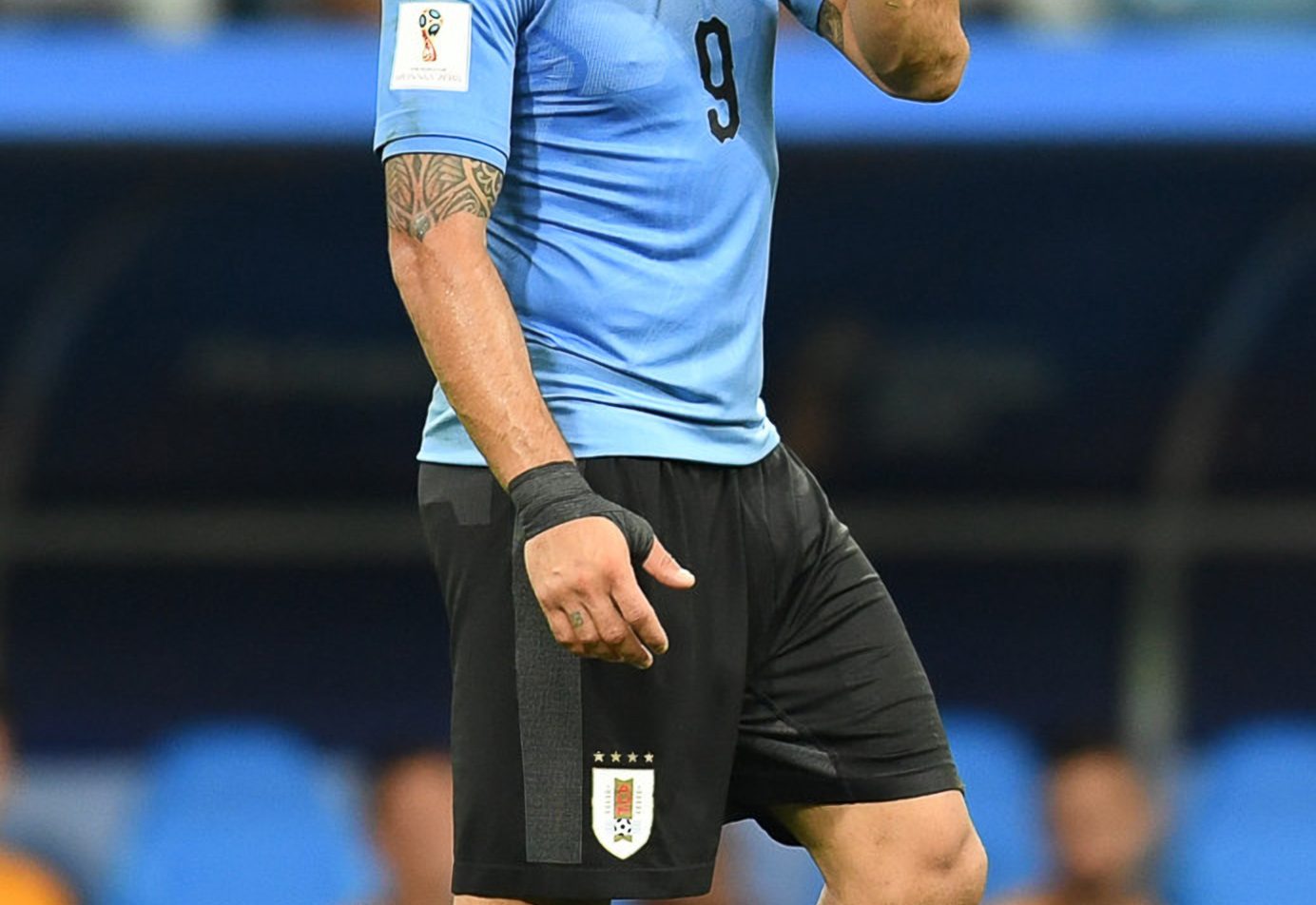
Suárez made his senior international debut against Colombia in February 2007 and was sent off. His Uruguay career ended with far more substantial numbers: 69 goals in 143 appearances, making him the country’s leading men’s scorer.
He played at four World Cups, from 2010 through 2022. In South Africa, Uruguay finished fourth, although his deliberate goal-line handball against Ghana became one of the tournament’s defining controversies. He was dismissed, Asamoah Gyan missed the resulting penalty, and Uruguay advanced through a shootout.
A year later, the achievement was less contentious. Suárez scored in the 2011 Copa América final as Uruguay beat Paraguay 3-0 and was named player of the tournament.
He retired from international football in September 2024, making his farewell appearance against Paraguay in Montevideo.
Instinct, movement and life beyond football
At his best, Suárez made defenders uncomfortable before the ball reached him. He leaned into challenges, changed direction sharply and found shooting angles with either foot. His combination play was just as important: the striker could finish a move, but also create the opening that made it possible.
Away from matches, family has remained central to his public story. He married Sofía Balbi in 2009, and they have three children: Delfina, Benjamín and Lautaro. Their relationship began long before the European trophies, a point he has often returned to when discussing his early ambitions.
His charitable work includes supporting Uruguay’s Fundación Pérez Scremini, which treats children with cancer. He has also contributed food and essential supplies to relief efforts, including after flooding in Salto in 2016.
Those activities offer a different view from the confrontational figure seen by opponents: a player whose life has stretched across several countries, but whose strongest personal connections still lead back to Uruguay.
FAQ
When and where was Luis Suárez born?
He was born on January 24, 1987, in Salto, Uruguay.
Who is his wife?
Suárez married Sofía Balbi in 2009. They have three children.
How many goals did he score for Barcelona?
He scored 198 goals in 283 competitive appearances, including 147 goals in La Liga.
What does El Pistolero mean?
His nickname translates as “The Gunman,” a reference to his goalscoring.
How many goals did he score for Uruguay?
He retired from international football with a national-record 69 goals in 143 appearances.
How many biting incidents resulted in bans?
Three: against Otman Bakkal in 2010, Branislav Ivanović in 2013 and Giorgio Chiellini in 2014.
Photo: Анна Нэсси, CC BY-SA 3.0, via Wikimedia Commons